The Evolution of Apartment Gyms & Why You Want One In Your Building

The Era of Apartment Gyms

Yep, moving into your first apartment may work up just as much sweat as a workout. But if you’re planning to hit specific fitness goals, you’ve got to put in the work! You have to sign up to a fitness centre, use up your precious time travelling AND spend loads on membership fees. So – why not choose apartment buildings that have their own gym??

Apartments are really upping their game with lifestyle amenities, with cinemas, communal rooftops and gardens that bring residents together. But in fact, an apartment gym is one of the most IMPORTANT amenities in the eyes of first-home buyers and investors.

Let’s take a look at why an apartment gym is a must on your checklist for your next home.

Apartment Gym ideal equipment

Ideal equipment for your apartment gym

Where it all began

Apartment gyms have come a long way. You’re probably picturing a small room, with a handful of weights, and perhaps a stationary bike and treadmill. If you’re lucky, the apartment building may even have a pool to cool off in after a long day at work.

But since then, those tiny gyms have levelled up. They are bigger, better-equipped fitness centres, with heaps of new gym equipment and more space to exercise. Some even have a hotel standard pool, spa or other sweet amenities that amp up the entire apartment building. So there’s no excuse to skip cardio!

There’s no doubt that Australians, especially millennials, are passionate about exercise, health and wellbeing. Property managers and developers have definitely taken this into account, as with each new high-rise development, gyms are now often seen as the focal point of the building, even taking up penthouse rooftops for residents who love training outdoors.

According to Domain, most residential developments back in 2012 and 2013 typically didn’t include any shared spaces.

“Today, we generally always include them” – Andrew Peters, Hallmarc Development Manager.

STPG WOVA Project CGI - Image of gym

Liviti’s Top Apartment Gym Features

  1. Rooftop

    An apartment gym perfectly positioned high up on the rooftop, rather than a basement, is a perfect way to allow residents to enjoy natural light and good sunset views. If your apartment is in a nice location, you’ll be able to soak in the sweeping city or water views whilst getting your exercise in.

    For investors, it’s also good to note that for most apartment buildings, a luxury rooftop gym can influence apartment rental prices significantly. A ground floor workout room doesn’t have as much of an impact.

  2. Good range of equipment

    A simple element, but super essential! The most important part of a gym is the equipment it has!

    An apartment gym with a cable machine, treadmill, stationary bike, a few benches and free weights ticks all the boxes. So if you’re a runner, lifter, or somewhere in-between, you’ve got all that you need.

Apartment Gym - Luxury

Luxury Apartment Gym

  1. Other cool amenities

An apartment gym complemented by other amenities such as spas, saunas or pools definitely turns heads. Some spaces even have wellness features, such as indoor gardens or yoga spaces for those who want to just chill out at the end of a long week. What a dream!

STPG - WOVA Project CGI image of pool

Benefits of a gym in your apartment building

No monthly membership fee

Yep, you don’t need to pay your standard gym monthly membership fee if your building has a gym. This is a great benefit if you’re buying your first apartment since you’ll probably have heaps of costs to cover and need to save up.

At a standard gym, once you sign up, you might be locked into a contract, meaning that it can be pretty difficult to cancel. But in an apartment, there’s no contract, and your gym costs are included in the fees you pay for access to other services in the apartment building. Sweet – you’re basically lifting for free!

Convenience

Having an apartment gym in the same building = convenience! No need to search for a gym or travel far lengths to get there, because you’re in the prime location – just minutes from your doorstep!

You don’t have to worry about ease of access, time management with your schedule or transportation costs. If you lack the motivation to work out – this extra convenience is a win!

Less people

Say goodbye to ‘bro hour’ – the notorious term for that peak time in the gym (mostly dominated by men), where all of the equipment disappears and you probably have to just use your own body weight. So if you can’t stand crowded spaces, or feel easily overwhelmed or claustrophobic, you might want to stay in your apartment building. In an apartment gym, you can enjoy a space with fewer people, so there’ll be more equipment to enjoy and no need to ask the guy next to you how many sets he has left.

Social Opportunity

Who doesn’t like making new friends? In a standard gym, you’re surrounded by people that you don’t know. But in an apartment gym, you’re sweating alongside people that live in the same building as you. This creates a perfect opportunity to strike up some friendships, or even find a partner to work out with you and boost the motivational energy!

(Source: Bruce Mars - Image of woman sitting on yoga mat with in front of girl)

Possible Increased Rental Return (For Investors)

Since they can use their apartment gym, tenants may cancel any existing gym membership. So investors can consider requesting a higher rent, compared to buildings without an on-site gym. This means that you can possibly get an increased rental return! If you like the sound of that, invest in an apartment with an on-site gym and you’re in business!

Gyms are the way to go

Whether you’re a fitness guru looking for your first apartment, or an investor searching for the best building perks, make sure it has a gym or fitness centre for all your lifestyle needs!

Contact Liviti at 9056 4311 or get in touch here if you need professional guidance on your property journey, or even just to get your foot through the door!

Where Will Rihanna Raise Her New Baby Boy?

‘Bad gal Riri’, better known as Rihanna, is a Barbadian R&B singer, businesswoman and NEW MUM! Everyone has been raving about Rihanna’s baby boy and her relationship with rapper A$AP Rocky – but who didn’t know that? It’s Riri! 

But something you might not know is that Rihanna has one of the most IMPRESSIVE real estate portfolios. 

With Rihanna welcoming her first child and recently reaching BILLIONAIRE status, where will she be raising her family?

(Image: @badgalriri)

Rihanna the Property Investor 

Thanks to her widely popular Fenty makeup brand, Rihanna has become the world’s wealthiest female musician. She has definitely become the definition of ‘Girl Boss’. With that, and the continued success of her brand, Rihanna has made many smart property investments.

Over the years, she has owned, rented and sold several homes: 

1. Luxury New York Penthouse 

2. Mediterranean-style Mansion, Hollywood Hills, California

3. Beachfront Condo, Barbados

4. London Mansion 


5. Mansion in Pacific Palisades, California 


But these are just a FEW of the properties that Rihanna has called home. Her favourite is believed to be her most stunning home, which may be where she plans to raise the newborn baby. 

Rihanna’s Beverly Hills Farmhouse

Rihanna’s house in Beverly Hills is believed to be a strong contender to become the new home for her and A$AP Rocky’s new family. Last year, she even bought the house next door for $10 million. Could she be expanding for more babies to come?? We hope so!

Source: US Weekly - Image of Rihanna’s Farmhouse


The singer’s Beverly Hills Farmhouse is a $13.8 million dollar modern farmhouse, originally built in 1938. The 700 square metre home comes complete with a stunning custom pool, exterior and interior fireplaces and a cabana terrace. 

Source - US Weekly. Image of Rihanna’s custom pool


Its main suite has a huge walk-in wardrobe with black lacquer cabinetry, a luxurious marble bathroom and a terrace with sweeping views of the hills and mountains. With five bedrooms and seven bathrooms, Rihanna can raise many more children here! 


Source: Alexis Adam - Image of black lacquer cabinetry in custom closet

“I’ll have kids — three or four of ’em,” Rihanna said in an interview. 

Source: US Weekly. Image of spacious, marble bathroom

Rihanna sure knows how to score first-class living! There’s no reason why anyone wouldn’t want their baby growing up in a mansion like hers.

Since Rihanna gave birth to her baby boy in a Los Angeles Hospital on the 13th May, could living in Beverly Hills be on the cards? 

What is the Best Apartment Floor to Live On?

Apartment Levels

So, you’re on the hunt for your dream apartment. You’ve thought about location, proximity to schools, public transport, and the energy of the neighbourhood. BUT – have you thought about which level you should live on?

It may all come down to personal preference, but before you secure your next apartment, you should consider the perks of each apartment floor.

READ ON to discover the ins and outs of each apartment level!

Giving your furry friends or the kids a real treat with space in a ground floor apartment

If you’ve got an energetic cavalier, or young kids, you’re probably keen for an apartment that has prime space. Luckily, a ground floor apartment provides just that!

Ground floor apartments usually come with a private garden or courtyard, perfect for cooking up a barbecue for guests and letting your children and pets run around (don’t forget to get approval from strata for your pets). These outdoor spaces are usually larger than balconies, and they almost act as an extra room. So you get more room for entertainment, loads of fresh air, and great space for pet owners and parents – woohoo!

Hey, but there’s more!

1. No Stairs

A ground floor apartment generally has fewer or no stairs at all – YES, your grocery hauls just got ten times easier. Fewer stairs also allow for an effortless move in and cater for less mobile or elderly relatives. Plus, in case of an emergency evacuation – you’re the first one out!

2. No neighbours below

Gone are the days of worrying whether you are bothering your downstairs tenants – because there are none! On the ground floor, your kids can play, stomp and run around freely.

3. Cooler temperatures

Who doesn’t like saving money? Since heat rises, ground floor apartments enjoy cooler temperatures in the summer months, meaning you can save energy costs on air conditioning or fans.

Apartment Floor

For those living alone or looking to rent a place that doesn’t need a courtyard or patio, ground floor units may not be for you. If you prefer to have good views, lots of sunlight and warmer temperatures, why not level up and score a top floor apartment?

Living the high life in a Top Floor Apartment!

Yep, if there’s any home that just screams wealth and class, it’s a penthouse. We all swoon over top floor apartments, maybe because we want to enjoy the view, or maybe above others… But if you’ve seen Kim Kardashian’s former New York Penthouse, you’d want one too.

Apartment Floor

Let’s talk about the highlight of top floor apartments – the views. If your apartment is near the city or water, the top floor will undoubtedly score the best views. Not only will you be able to host the prettiest cocktail parties, but you’ll be able to attract premium selling prices if you decide to move! The icing on the cake is, of course, the balcony to enjoy the view.

More pros include:

1. More security & privacy

Top floor apartments are usually positioned further away from the street, with windows that are not accessible from the outside. If safety is a top concern, you’re good up here!

2. Light, light & more light

Who doesn’t love more natural light? You’ll be warm and cozy in those cooler months in a top floor apartment with more exposure to light and rising heat. This is important in inner-city areas, where tall buildings overshadow others. Thankfully, you can save energy costs by using less heating and enjoying the natural light flooding into your living spaces.

3. Less noise

Living at the top means you’re far from street noise and vehicle traffic noise. The volume from underlying neighbours is minimal and there’s no-one above you either. You can sing in the shower as loud as you want!

Apartment Floor

If you don’t want to work up a sweat with long flights of stairs, or endure the warmth of the top floor, this may not be your personal choice.

Hauling a bike, groceries or going to greet guests or delivery partners can become a challenge from the top floor (depending on the video intercom available), so why not consider going for a middle-level apartment instead?

Don’t forget what’s in between – The Middle Level Apartment Floors

So, you’ve thought of living on the first floor and the top floor – but what about the middle? Much like the best part of a sandwich, the middle floor is a prime level in apartments. It offers the best of both worlds and has heaps of benefits to consider!

Life in the middle is a big win for your energy bills. Without air conditioning and heating, the higher floor tends to be challenging to cool down during summer, and the ground floor is difficult to heat up during winter. So being in the middle means your bills are more consistent, and you won’t have to worry about up and down temperatures!

Apartment Floor

Other perks include:

1. Lovely views

Living on the middle level still offers better views than a ground floor apartment! You can enjoy your views from the balcony, and probably for a lower price than a top floor unit.

2. Easy access

You may still get a workout from the stairs (if you’re not opting for the lift), but there will be less to worry about compared to living on the top floors. And the best thing is – there’s less wait time for lifts too!

Other things to consider

Before deciding your apartment floor you should live on, there are loads of other things to think about! At the end of the day, you want to pick an apartment complex that suits YOU (or your tenants) and fits your unique flair and lifestyle.

1. Price

Check the purchase price that comes with the apartment floor. Top floors usually come with higher prices, and the first floor may mean more bills for heating. You could stick to the middle levels if you want consistent billing prices.

2. Proximity

Is your apartment floor close to any laundry rooms or shared spaces, such as a pool or gym? Does your apartment complex have communal spaces or barbecue areas that you want to be close to? Check the proximity of your floor to amenities – if you want to be close to them (or far!) make sure you pick the right level! If you have less mobile friends or relatives consider the accessibility of your floor from the entrance.

3. Location

Probably one of the most important things to consider before you buy! Do you have children who need to be able to walk or catch the train to school? What about proximity to parks and shops for your daily needs? You don’t want to be too close to noisy street areas, nightclubs or dining precincts either. Don’t forget to consider where the apartment itself is situated.

Discover more on The Pros & Cons Of Apartment Living In Australia

What does our team say?

We’ve asked our team at Liviti which apartment floor they prefer and why!

Here is what we found:

“Top floor, for more privacy, less noise, good views, and perfect sunlight. Even facing south gives good neutral light” – Kevin

“Ground floor – dual entry point from the courtyard and your front door” – Jeremy

“My ideal choice would be Top Floor. I would enjoy the natural light received in a top floor apartment and the beautiful outlook over the district and possibly even towards the bay or city. Often Top Floor Apartments come with a higher price tag, in which case I would then opt for a Middle level apartment on a higher level. This would still give me amazing light and views.” – Lara

“My dream apartment would definitely be from the middle level up with a lot of glass to maximise the views. There is something about living up high with great views that always make me feel so relaxed, especially if it’s a city view at night time. And yes, for me, views is the most important feature!!” – Lucy

So before you secure the deal on your next unit, think about which floor you want to live on!

Contact Liviti today for more helpful property tips and news, or to find, fund, buy and live in your new apartment!

Alicia Xiberras’s Apartment Living Tips and Tricks

We all know that a well-lit apartment is hard to find. So if you own an already well-styled apartment, CONGRATULATIONS, you are already ahead of the game!

But for everyone else who is still struggling to make the most out of your apartment living, you might have to employ some clever tips and tricks. Which should be easy because we have already done all the homework for you.

We interviewed renowned Australian Interior Designer, Alicia Xiberras on the art of  “acing apartment living!”.

Alicia is the Director of Alicia Xiberras Interiors (AXI), a female powerhouse of Interior Designers brought together by their passion to create beautiful spaces and interiors.

Recognised as one of Australia’s most upcoming and promising designers, Alicia Xiberras Interiors offers a fresh, innovative and exciting take on a wide variety of design needs for both residential and commercial spaces. With over 15 years in the design industry, AXI is dedicated to helping you achieve your dream space, inspired by the latest design trends and catered to any design style.

Design Ideas with Alicia Xiberras - Interior Designer

And now, we are about to break our interview down for you in 3 … 2 …

1. What’s the biggest mistake people make when styling their apartment?

“The biggest mistake apartment owners tend to make is that they don’t focus on the scale of furniture in accordance to their room size.”

Designer Tip: Small Apartment’s don’t always = small furniture

Ensure you are using the right sized furniture to fill your space without making it feel cramped.

Think about your living space, if you value comfort, opt for a decent sized lounge and smaller storage space. If you value storage, opt for a smaller lounge and better storage options.

2. The second mistake to avoid

“Another mistake apartment owners are guilty of is trying to introduce a style in their space that doesn’t look accurate. When it comes to executing certain interior design styles, they require large spaces.

Designer Tip: “It’s important to understand that the style you’re intending to use works with the space.”     

3. We always hear the saying, ‘Bring the outside in’, But should we really?

“Today’s society very much craves the concept of “bringing the outside in”, especially in apartment living.

With COVID lockdowns impacting people’s perception of being outside, it’s important to ensure your apartment has qualities that can give the illusion of this concept.”

Designer Tip: Start by slowly adding some plants to your décor. Whether real or fake is up to you – *We don’t have a green thumb to keep plants alive either!*

4. What should I do if my apartment feels small?

“Consider natural light and the treatments on your current windows!”

“Also consider your flooring and wall colours. When a space feels small, a light colour palette and lots of natural light is a great psychological tool to assist with this issue.”

5. What are your top 5 design tips to ace apartment living?

“We recently designed an apartment in the heart of the Sydney CBD district, the project was called Australian indulgence. When we designed this apartment for our clients it was fundamental we considered these topics, to achieve the perfect apartment lifestyle for our clients.” said Alicia.

Let’s find out what Alicia’s Top 5 tips to acing apartment living are and trust us, You will want to TAKE NOTES!

Noise/ outside noise

“This is fundamental with apartment living as it can impact your wellness and sleep cycles.”

*We get it, no one wants to be woken up by the garbage truck at 4am or kept up every Friday night by the Pub across the street*

“Consider acoustics, like rugs or fabric furnishings within your apartment to collect any excess sound. “

Alicia Xiberras Interiors - Consider acoustics. Add Rugs or fabric furnishings to your living space

Natural light – How much do you really want?

“Bring the outside in and don’t be afraid to consider window furnishings that allow complete sunlight to saturate the apartment. It’s still important to also ensure that you can still have complete privacy or block out.”

Designer Tip: “A double roller blind, with block out & sheers overlaying will be the ideal selection for apartment living.”

Alicia Xiberras Interiors - How much light do you want in your apartment? Make the space feel larger with light

Furniture size

“If you are concerned with working with a tight or small space, always consider the scale of furniture in the room.”

For example, “if you have circulation issues, instead of a rectangle dining table top, consider an oval top, this allows a softer curve and further circulation around your dining table.”

Alicia Xiberras Interiors - Furniture size can make a room feel small or can make rooms feel larger

Accessorising

“I avoid over accessorising in styling and décor. This can make the apartment feel cluttered and overdone.”

Designer Tip: “Remember that old fashion quote ‘less is more’!”

Alicia Xiberras Interiors - Apartment Design Ideas

Colour pallets

“Avoid loud and dark colour pallets when the space is small!”

*Does anyone remember Matt & Kim’s ‘Panic Room’ from The Block 2013? – You don’t want to, what a nightmare! *

Matt & Kim's 'Panic Room' from The Block 2013 - Creating crazy walls

6. What’s your number 1 tip for those styling their apartment on a budget?

(And what they should splurge or save on!)

Save

“I think the best place to look at when sourcing furniture on a budget is Ikea or Facebook marketplace.”

Remember the saying: ‘One man’s trash is another man’s treasure!’ – It’s becoming even more true.

Splurge

“I would splurge on a decent lounge and mattress, when it comes to ergonomics in a living environment, never take shortcuts!”

Designer Tip: Comfort always wins in a living and bedroom!

Save

“In terms of Décor sourcing, always go to Kmart. They have great basics and have a decent selection when it comes to different styles.”

Did you hear that! Alicia Xiberras just gave us permission to Splurge in KMART.
So when your partner asks why you spent so much at Kmart, just show them this article 😛

Save- DIY

“Don’t be afraid to make things yourself! Pinterest is a great place to generate ideas. Whether it’s finding gorgeous dried tree branches in the park, shells at the beach or pebbles in the garden, the possibilities are endless.”


Okay! So Alicia has spilt the tea. It’s your turn to make the most out of your apartment. We’re excited to see you snag that place of your dreams!

Cash Flow or Gearing? Growth or yield? Understanding Property Investment Terminology

When it comes to property investment, questions like, “Which is better, positive vs negative gearing?” or “Should I go for yield or growth?” is kind of like asking, “Which is better, a hammer or a screwdriver if I want to mow the windows?”

Firstly, let’s start with understanding gearing.

Put simply, ‘Gearing’ means using borrowed funds. Investors typically ‘gear’ their investment properties because buying property for cash is really, really, really hard for ordinary Australians – even for those on incomes well above average.

If you know anyone with a mortgage, they have used gearing. If the property is their home, the gearing has no tax implications. If the property is an investment, the gearing will have tax implications.

So why use borrowed money or ‘gearing’ to buy a property? Why not just save up the money required and pay cash?

Imagine a 100m race between a bicycle and a Tesla. The bicycle represents the speed at which most Australians can genuinely save money and the Tesla is the increasing purchase price of an average property in the Australian market. Unless the Tesla has its wheels removed, the bicycle doesn’t stand a chance. And so it is with the ability for most Australians to save money quicker than property prices are rising. The majority of property buyers need a super quick injection of funding (borrowed money) to complete the purchase or they will never catch the market.

So now we know what gearing is, what is all the talk about positive and negative gearing? Is one better than the other and which is best for you?

So, What Is Negative Gearing?

Let’s apply a basic bookkeeping idea – debits on the left and credits on the right.

In simple terms, an investment property is negatively geared when the debits (you could also call them costs or expenses including interest, maintenance, insurance, strata, council rates and depreciation) are bigger than the credits (usually called rent or rental income). That is, more money is going out per year than is coming in.

Just like with any business, when more money is going out than is coming in, the business is making a loss. The difference when it comes to personal property investment, however, is what can the loss be used for and what does the ATO permit on your personal tax return.

So, in this case, the ATO will permit the property investment loss to be deducted from the annual income of the investor *YES!!

Let’s explore further using basic numbers – Meet Billy!

Billy is a worker in a local factory. He earns $100,000 annually for this job.

His investment property has a rental income of $20,000 and expenses of $30,000 for the financial year therefore Bill’s investment property makes a $10,000 loss. The $10,000 loss is then able to be deducted from Bill’s factory wage.

So, Bill will pay tax on $90,000 income not $100,000.

Benefits of Negatively Geared Property Investment

Capital Growth

Properties purchased for negative gearing outcomes generally show great potential for capital growth, with the end goal being impressive gains received upon the sale of the home.

As long as the property shows high potential for future growth and quality research has been carried out to prove this, capital gains should outweigh any losses incurred by a long shot.

Long Term Tenants

Properties with the potential to successfully negatively gear are often located in areas with low rent and high vacancy rates. Finding long term tenants in these kinds of areas isn’t usually too difficult, so if you find a good renter, they may be with you for the entire life cycle of the property which is a huge plus and means less stress for you, as the property investor.

Drawbacks of Negative Gearing

Potential For Negative Cash Flow

When purchasing a negatively geared investment property, it is advisable to ensure you have a stable income that is likely to increase over time. By ensuring this, you can cover any property expenses that may be incurred where rental income doesn’t cover.

Capital Gains Attract Tax

Keep in mind that 50% of your capital gains will attract tax. It’s important to take this into account when considering a property purchase based on negative gearing.

What is Positive Gearing?

You’ll often find positively geared investments referred to as cash flow positive properties.

A positively geared investment is entered into with the understanding that the property will attract high rental income and produce more cash flow from tenants throughout the life span of the ownership.

Essentially, the positive cash flow from rental income on these types of investment properties is expected to cover property prices and fees, while generating passive income for the homeowner.

Think of a property located close to a city where vacancy rates are low.

This may put you in a position to charge $600 per week in rent. Say the overall costs of owning the property average out to be around $550 per week.

This means your property investing strategy is immediately paying off, leaving you with a net return on investment of $50 per week.

And while your ‘business’ is making a profit, we need to consider the ATO’s rules to complete the picture. For a positively geared property, the ATO will add the investment ‘profit’ to the investors existing taxable income.

Now, meet Mary!

Just like Billy, Mary also earns $100,000 working in a local office.

Her investment property has a rental income of $30,000 and expenses of $20,000 for the financial year therefore Mary’s investment property makes a $10,000 profit. The $10,000 profit (considered taxable income) is then assessed in addition to Mary’s factory wage.

So, Mary will pay tax on $110,000 not $100,000.

How Does Positive Gearing Work with An Investment Property?

As mentioned previously, the ultimate goal of owning positively geared investment properties is to gain positive cash flow that will not only cover the expenses of the investment property itself but also provide a source of passive income for the owner.

The goal of this investment strategy is to gain wealth and stability, which is in line with investors who choose the negative gearing approach. It’s just a different way of going about it.

Rather than seeing high capital growth and selling when the time is right, investors focus on gaining income while the property is in their hands when negative gearing is the chosen strategy.

Essentially, they want to make sure they’re seeing a return on their investment throughout their entire ownership, not just at the end.

Benefits Of Positively Geared Property Investment

More Cash Flow

Though a property focused on positive gearing may see lower capital growth overall than one designed to negatively gear, the major plus is that you can use your own home from the get-go as a source of additional income.

You’ll see the fruits of your labour upfront as you receive rental payments from tenants that cover not only your maintenance costs, mortgage fees, interest payments and other expenses, but will also provide extra cash for you to invest, set aside as savings or spend as you see fit.

Increase Your Borrowing Power

Properties that aim for positive gearing outcomes tend to be considered a little less risky than ones with negative gearing goals, simply because the income received throughout the ownership is greater than the expenses incurred.

This can ultimately set you up with more borrowing power should you wish to expand your investment portfolio.

Versatile Option for New And Old Investors

Positively geared properties are highly attractive investment opportunities for both seasoned and rookie investors alike.

New investors can begin their portfolio with a property that offers less risk or financial burden until the eventual sale.

Established investors with an existing property that is positively geared have seen/are seeing the benefits first-hand, and will likely choose to grow their portfolio with similar properties.

Cover Losses of Your Negatively Geared Properties

If you do decide that you’d like to try your hand at owning a negatively geared property, you can utilise the income from your existing properties built around positive gearing to cover any losses incurred so you’re not left out of pocket.

Drawbacks Of Positive Gearing

Your Rental Income Will Be Taxed

Yep, income from rent is taxable income so the ATO is going to want their share of your rental income as you receive it. Be sure to incorporate this into your tax payable calculations when deciding whether to go ahead with your investment.

Fluctuating Or Slow Capital Growth

The majority of properties with positive gearing benefits tend to be located in or near rural or regional towns, which can often affect the capital growth of an investment. This may take a toll on your ability to access equity to fund other prospective investments.

Low Rental Yields Can Negatively Impact Your Cash Flow

As mentioned above, one of the major benefits of positive gearing is positive cash flow. This can be negatively affected by low rental yields, depending on the state of the property market and other economic and social factors.

What about Neutral Gearing?

Yes, if you’re wondering is there a “neutral” gearing option, there is!

This concept happens where the amount of money going out per year is the same as the amount of money coming in – enough rent is received over twelve months to exactly cover the full cost of all the outgoings.

But, this usually doesn’t happen naturally and probably requires some creative accounting to make happen year on year on year.

Neutral gearing is more likely to be found in the space surrounding seasoned property investors with multiple property investments; whom by default have more moving parts than first-time investors. This will generally allow accountants more wriggle room to ‘carry the one’.

Looking at the numbers for your investment strategy

Okay! But what has positive or negative gearing got to do with hammers and screwdrivers?

Positive gearing and negative gearing should be considered separate tools available to investors to assist with certain investment (tax) outcomes. Positive and negative gearing can also be used to create opportunities that otherwise might have remained out of reach.

Just like there is no perfect approach to renovating, there is no one investment gearing tool that does all jobs. Much will depend on many varying factors.

If Mary’s goal is to reduce the amount of personal tax she pays, her positively geared property isn’t helping her.

If Bill is struggling with cash flow and generally finding it hard to make ends meet, his negatively geared property isn’t helping him (since now he needs to personally fund the $10,000 loss: $200 per week out of his own pocket).

Then Which Is Better, Positive or Negative Gearing?

The end goals of both positive gearing and negative gearing investment strategies are very similar: to gain wealth and stability through well-researched property investment opportunities.

As with all property investment, it is important to weigh up the different factors like overall taxable income, the depreciation schedule of the property, any tax benefit that may be afforded, any tax deductions that may come into play, as well as interest rates and more.

It’s always best to seek independent financial advice on any investment you plan to make but essentially, when it comes to negative and positive gearing, those investors with a steady income stream that is likely to increase could consider negative gearing as a quality investment, while investors who prefer an opportunity that will provide positive cash flow throughout the ownership could benefit from a positively geared property.

keys on hand

All in all..

If you’re interested in finding out more about positive and negative gearing or property investments in general, please don’t hesitate to reach out to our team of experienced and highly skilled real estate experts.

We can help you find the positively geared property, as well as negatively geared opportunities to suit your specific circumstances.

Pick up the phone and call (02) 9056 4311 for a friendly chat today!

If gathering info online is more your style, we’ve got a contact form where you can send us a message.

The Ultimate Guide to Finding the Best Rental Yield Australia-Wide in 2022

For many, being able to buy a property in the Australian suburbs close to one of the major capital cities is “the dream”.

Unfortunately, this dream is quickly followed by the reality of a home loan, interest rates and monthly repayments of a mortgage.

Investors, however, see these properties as future income and assets, rather than liabilities. Savvy investors can very quickly reduce home loans by listing their investment property on the rental market and taking advantage of buying in areas that produce great cash flow and aiming to achieve the best rental yield possible.

An increase in cash flow and profit from a rental property is certainly possible by researching where there is rental demand, where the best rental yields can be found and by obtaining strong knowledge surrounding capital growth.

red blocks on brown wooden table

What is Rental Yield?

Rental yield is the profit an investor receives per year from a property, as a percentage of its purchase or current value.

Essentially, in simple terms, rental yield is a figure that can help a homeowner understand how well their property is performing in the current market by providing valuable information in a simple, easy-to-understand format.

The yield figure can be used to compare the investor’s properties with other properties in the area, as well as being valuable information when it comes time to make decisions.

Generally speaking, a higher rental yield means more potential for rental returns for investors from annual rental income.

There are two different types of rental yields that all investors should be aware of, whether they’re just entering the game or are seasoned veterans.

What Are the Two Types of Rental Yields?

There are two types of rental yields, these being gross rental yields and net rental yields. Both play an important role in helping investors make informed decisions regarding their investment portfolios.

Here’s what you need to know…

Gross Rental Yield

Firstly, let’s discuss gross rental yield.

This relates to the total annual income received from an investment property through rent, before tax.

After the annual rental income before tax is calculated, the gross rental yield is then transformed into a percentage of the property’s purchase cost or current market value.

Net Rental Yield

Now, the second type of rental yield is net rental yield, which is calculated by adding up the total income of a rental property, then taking away expenses or purchase transactions, for example, monthly fees or the charges local agents might tack on for marketing and property management.

As with gross rental yield, the net rental yield is produced as a percentage of the purchase price (or current property value) of the rental property.

How is Rental Yield Calculated?

We know we touched on this briefly in the section above, but here’s a bit more of an extended explanation as to how rental yield calculations should be carried out.

If you’d much prefer to skip over this part and just have someone like an Australian financial services licensee do the math for you, be our guest. Numbers can be super tedious sometimes, though it does often pay to learn about these things yourself. You do you, fam.

How to Calculate Gross Rental Yield

Calculating gross rental yield simply comes down to dividing annual rental income by the value of the property and multiplying that by 100 to get a valid percentage.

Here’s the gross rental yield calculation formula…

Gross rental yield = (annual rental income/property value) x100

And an example…

Let’s say a guy named Mike purchases a property for $800,000. Rental prices for the property have hit an all-time high of $600 per week (lucky Mike!).

As the property owner, in order to figure out the gross yield, Mike would need to multiply the weekly rent figure by 52 to find out the annual rental income ($31,200), then divide that figure by the property purchase value (0.039), then times that figure by 100 for a gross yield percentage of (drumroll, please)…

3.9%

Did you get that? Or have we lost you? Feel free to run your eyes over that one more time, we know it’s a lot to take in on the first read-through.

Now, moving on to our second calculation explanation…

How to Calculate Net Rental Yield

Calculating net yield utilises the same formula as gross yield, but it takes into account any expenses incurred throughout the year that relate to the property.

Here’s the net rental yield calculation formula…

Net rental yield = [(Annual rental income – annual expenses) / total property cost] x 100

And an example (Mike’s back)…

Now, Mike wants to know what the net yield of his rental property is sitting at.

First, he will need to calculate the total of his annual expenses incurred from this particular property investment. Let’s say he’s spent $3500 on things like insurance, repair costs, agent fees and mortgage repayments (among other expenses, but let’s keep it as simple as we can for now).

So, Mike is going to take the $3500 expense total and minus it from his annual rental income amount ($27,700), then he will divide that amount by the total property cost (0.035), and finally, multiply that figure by 100 for a net yield percentage of…

3.5%

We get that this stuff can be hard to wrap your head around if you’re a first-time investor, so please don’t hesitate to reach out to us directly and ask to speak with one of our super friendly (and highly experienced) property experts. They know exactly how you’re feeling…after all, we all have to start somewhere, right?

What is The Importance of Understanding Rental Yield?

Understanding rental yield can help investors gain a better understanding of cash flow, work on an investment strategy for the future, figure out whether they may be able to afford a particular home loan amount on a new property, consider their personal objectives and whether the property is working well for them and see how their home is standing in relation to the rest of the property market.

In short, understanding rental yield can help an investor determine both affordable property prices and those that may be out of reach, given their personal circumstances, among an array of other helpful tidbits.

black pencil on white printerpaper

What Other Factors Should Be Considered Alongside Rental Yield to Provide Property Insights?

Vacancy rates

The statistic used to determine the number of vacant properties on the market at one time is known as the vacancy rate. The vacancy rate is normally calculated as a percentage, by dividing the total number of properties currently for rent by the number of properties currently listed.

Knowing the vacancy rate in a particular area is a fantastic way to compare the viability of purchasing a property there and can assist greatly in working out the best rental yield suburbs for consideration.

Generally, the lower the vacancy rate, the better chance the suburb will produce high yield properties. Of course, this isn’t always the case and proper care should be taken to perform thorough research before purchasing a property.

Growth pattern trends and insights

Studying growth patterns and other trends can assist an investor in determining whether the median rental yield, interest rates and home loan options of a particular area, or the entire market, at any given time, is going to provide strong capital growth, best rental yields and other favourable outcomes.

By studying statistics like the median weekly rent and median sale prices, profitable locations can be ascertained; median rental yield can often be determined as an approximation by using these two figures (again, not always, but often).

It is important to note that one issue with using median rental yield to determine potential profit is that property prices in the area may have increased over time after the initial purchase, therefore the investor’s rental yield may end up lower than the median for the area.

Overall, it’s safe to say that studying the median prices in capital cities, regional areas and city suburbs, alongside other information and statistics can assist both current and future investors in successfully growing their property portfolios.

What is a Good Gross Rental Yield?

It is honestly quite hard to accurately define what a good gross rental yield is. If anyone tells you they know exactly what yield is the best for you (or the best in general)…tell them, in no uncertain terms, to cut the crap.

Sure, we can speculate. A lot of property experts will say that a rental yield of around 2-3% higher than the current variable mortgage rate is good, or a percentage of 5-6% higher is great. But that’s all it is…speculation.

The truth is that a good rental yield depends entirely on the circumstances of the buyer. Things like…

  • Their current financial situation and whether they have a steady stream of income.
  • Specifics of loans including loan term, loan amount, credit provider and other options available to them regarding home loans.
  • What they define as affordable property prices.
  • Their goals when it comes to entering the rental market as a property investor and where they want to take their portfolio.
  • And a whole lot more!

The circumstances of the purchase come into play as well. For example, a property’s rental yield at present may be lower than average but the median property values of the area may be on the rise – which can help to increase the rental yield over time.

Suffice to say, there’s no blanket ‘best yield figure’. It’s all a matter of circumstance.

Hand Gesture, Hand, Icons, Thumbs Up, Thumbs Down

What will happen to Rental Yields in The Future?

See above. Much like the issue of nobody knowing exactly what a good rental yield is, nobody has a crystal ball that can tell them exactly what will happen to rental yields in the future.

Sure, a credit provider, home loan expert or real estate professional may be able to make educated guesses, but the only certainty is uncertainty, we’re afraid.

Regardless, here are a few ideas and thoughts that we’ve heard through a trusted source recently…

“Post-COVID, growth rates will moderate the most in Melbourne, Darwin, and Sydney in the coming years.”

“Capital cities, and even more so regional locations, have the potential for between 20 to 50% capital growth over the next two to three years.”

“Propertyology is forecasting dollar-value rental incomes on standard houses to rise by as much as $10,000 in the 2022 calendar year.”

“International borders opening will definitely increase rental demand as that equates to more people looking for housing.”

Things certainly seem to be looking up, so now is the perfect time to deal directly with our team of Liviti property experts when it comes to starting or expanding your investment portfolio.

We can help you find a relevant credit provider and give you solid advice regarding the rental market, home loans and more, as well as send you in the right direction towards a trusted home loan product provider’s web site.

Is My Rental Income Taxable?

In short – yes *cue boos*.

An investor will be taxed (through capital gains tax) on the amount they profit from their rental investment property.

Rental income is defined as the total amount of rent or payments received from a rented property and must be included on the investor’s tax return.

There is a silver lining, though. Often investors will be eligible to apply for exemptions, discounts or concessions which may result in a cut down portion of the payable capital gains tax (CGT) amount. CGT concessions are definitely worth looking into.

Free Tax Documents on the Table Stock Photo

Read more about capital gains tax here.

What Are the Risks of Buying an Investment Property in High-Yield Suburbs?

There are always risks involved in purchasing investment properties.

Here are a couple that relate to buying in high-yield suburbs that may or may not affect you, depending on the research you conduct to invest wisely and the individual circumstances of the property itself…

Low capital growth

Low capital growth can be extremely detrimental to those investing in property.

Low growth means, in simple terms, that the property value is increasing at a slow rate when compared to the original purchase price.

Though the property may be experiencing high yield, overall growth can be heavily affected by supply and demand in the area with growth tending to be lower in areas with high supply and low demand.

High vacancy rates

Vacancy rates refer to the number of rental properties on the market which are unoccupied in a particular area.

When the vacancy rate is high, it provides more choices to potential tenants, at times putting pressure on rental prices for property owners.

It is often suggested that buyers invest in areas that have a wide variety when it comes to the demographic of possible renters, for example, the suburbs on the outskirts of a capital city and semi-regional areas (but not too regional).

Australian Suburbs with High Rental Yield in Recent Years

A 2020 article printed recent data released by CoreLogic, outlining the following areas as the best rental yield suburbs in Australia…
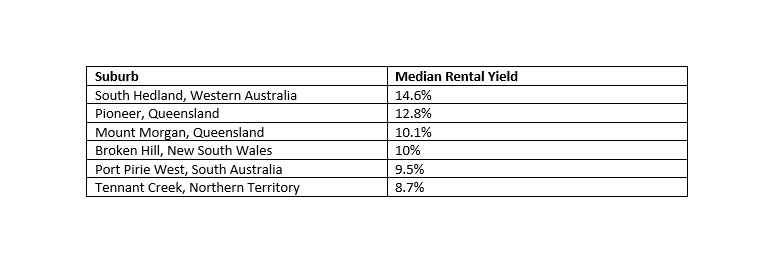
Queensland’s Gold Coast region, Broken Hill, the Northern Territory, and South Australia all make the cut, but it seems that Western Australia takes the cake in this battle to determine the highest rental yield suburbs in Oz!

It’s worth noting that, within the same study, the Central Coast region of New South Wales had quite a few areas with a relatively high rental yields that missed a mention in the table above.

Blue Haven, Charmhaven, and Watanobbi had rental yield values of 4.7%, 4.5% and 4.4% respectively, and all maintained a median weekly rent between $430 and $470.

map of Australia

Conclusion

All in all, our main message here is…

Don’t go pulling your hair out trying to figure out the exact numbers when it comes to the best median rental yield for an area, specific rental yield for your property or the best rental yield in general.

Do your research, deal directly with the experts and take all other relevant factors into account when it comes to property investment, rather than focusing solely on the highest rental yield stats.

If you’d like to take a look at our available properties for purchase, feel free to do so. Any questions, call our office on (02) 9056 4311 or contact us here and we’ll be happy to help.

Dual Key Apartments: Are They A Smart Option For You?

With the price of houses on the rise in the Australian market, it can be disheartening for bright-eyed and bushy-tailed investors who are new to the property scene to constantly be outbid at auctions. We know how hard it is right now to find investment opportunities within a certain range of affordability that will actually provide a decent return on investment.

The reality is that no matter how high housing prices soar, people still need a roof over their heads and there is always an alternative opportunity for those willing to take a different route.

One of the most commonly overlooked ways to break into the investment market is by placing your funds and your faith (with research to back it, of course) into a dual key apartment. Ok, so, why not just buy a house with a granny flat or invest in a humble duplex? Sure, they are both similar options, but a dual occupancy apartment does offer quite a few benefits that a granny flat or duplex simply cannot provide.

Let’s chat more and we’ll see if becoming a dual key apartment property investor is a smart option for you and your circumstances.

What Is Dual Key Apartment Ownership?

By purchasing a dual key apartment you’re essentially making a property investment that boasts two separate living spaces contained within a single apartment. Some might even say that you’re getting two properties for the price of one.

This can obviously pan out to be an amazing opportunity for investors, whether the home is purchased with the two separate properties already sectioned, or if the plan is to renovate to make it so. Kind of annoying that you need strata/council approval to renovate an apartment, but at least there’s a chance, right?

The main benefits do stem from the fact that dual key apartments are typically self-contained with a kitchen, separate bathroom, separate living space, and bedroom or bedrooms divided into two fully functional living quarters. The occupants will generally only share a front door and foyer, sometimes, not even that.

Why Are Dual Key Apartments On The Rise?

Free Black Handled Key on Key Hole Stock Photo

The main reason these types of properties are in high demand is that urban areas are experiencing a lack of space to build, but demand for housing is rising. Essentially, people need living spaces and they need them now. The rate at which we’re constructing residential buildings is struggling to keep up with the number of people who want to live in cities.

An investor with a keen eye can benefit from this need for urban living without having to buy multiple properties. Dual key apartment property investment allows a property owner to take advantage of a two-for-one deal. They can own two income-producing properties in just one space. In this economic climate, even Bunnings would struggle to offer that kind of value.

What Is The Difference Between A Dual Key Apartment And A Duplex?

photo of dual key apartment building with stairs

Though duplexes and dual key apartments do have some similarities, they’re more like cousins than siblings, with quite a few integral differences to consider.

Duplexes are two attached dwellings, both with their own claim to the title of ‘main property’. A duplex can also have two separate owners for each property, whereas a dual key apartment is owned by a single property investor.

Dual key properties are contained within one space, for example, an apartment, whereas a duplex is two completely separate properties with separate access points that may share a common boundary.

A dual key apartment might have a shared front entrance or be connected by a shared foyer with two lockable doors through which the residents can enter and exit, but sometimes a separate access point is included.

It is quite common for dual key apartments to be presented in a multitude of layouts, often located in high-rise apartments; they could be mirrored units, or have one or two bedrooms in one half of the space and a studio apartment in the other half. The floorplan opportunities are endless!

Advantages vs Disadvantages Of Investing In A Dual Key Property

Free Joyful young couple dancing after moving in new purchased apartment

Advantages Of Investing In Dual Key Apartments

1. Potential To Receive Dual Incomes

The fact that a dual key apartment is listed on one single title under a single home loan opens the door to massive income potential and decreases outlay for property investors. Unlike duplexes, in which properties are on separate titles, a dual key home can allow for two rental incomes through dual occupancy within one apartment.

High rental income and the potential for positive cash flow are huge benefits for property investors aiming to achieve higher profits.

2. Live In One, Rent Out The Other

Trying to decide whether to buy an apartment and live in it or rent it out? Porque no los dos? *cue cheers*

apartment security lock

With a dual key apartment, you, as the investor, can live in one part of the property and rent out the other. This can help subsidise loan repayments and boost cash flow while giving you a platform to break into the investment market and gain valuable experience. You get the best of both worlds, all in one!

3. Care For Family Members By Keeping Them Close By

As we get older, our parents and grandparents age too. Sometimes an elderly relative may need us to stay close in case of emergencies or just to help with tasks they can no longer carry out themselves. The same goes for family members with disabilities who may need a helping hand.

Residing in a dual key apartment together allows a family to stay close, while still offering a tremendous amount of privacy, freedom and space to all parties involved.

Family living in apartment dwellings

4. One Set Of Fees And Enticing Tax Benefits

Purchasing one property and incurring a single set of fees is definitely a drawcard for investors. With a dual key property, strata fees are generally much more streamlined as you are only paying for one property, rather than two dwellings or more.

The benefits also flow into other areas like council rates, as well as decisions made around approving mortgages and home loan considerations. Honestly, this can result in a big win for owner-occupiers who are looking to offset fees like property management costs and mortgage payments against rental income.

Now, let’s talk tax. Because dual key apartments are a relatively new innovation in Australia, you can generally take advantage of depreciation when the tax man comes knocking. Not a bad way to celebrate the end of the financial year!

5. Ability To Provide Affordable Housing For Students

Not only does it feel good to provide affordable housing opportunities, but it’s also nice to offer students a private place where they can live and study off-campus, away from distractions, without having to pay a fortune.

Students see the benefits of living in dual key properties and will likely be attracted if the residence is located close to their university campus with nearby access to public transport.

person writing on brown wooden table near white ceramic mug

6. Ability To Convert Back To A Single Dwelling

As the owner, you may wish, after some time, to convert the dual key property back into a single residence.

The best part about dual key apartments is that the floorplan is almost always simply a single apartment layout divided into two dwellings. This often makes the renovation process as easy as knocking down a few walls to open the space up and turn two apartments into one.

It’s the perfect opportunity for an investor who plans to retire to their investment property or convert it into a larger single dwelling to create extra space.

There is a catch to this, though! You must gain strata/council approval for reno plans. You can’t just go knocking walls down willy nilly, because it could affect the stability of the entire building, not to mention annoying neighbours with the noise.

Disadvantages Of Investing In Dual Key Properties

Dual key apartment Australia

1. Possibility Of A Premium Price Tag And Potential For Lower Buyer And Tenant Demand

Due to dual key homes being a recent emergence on the market, investors may end up paying top dollar. (Not always!) Though this generally isn’t an issue in the long run as the property sees capital growth, it can be problematic upfront.

A diverse rental market is something investors also have to contend with. Dual key properties are typically used as combination rental properties and owner-occupied spaces, thus may not draw in buyers who are not owner-occupiers, or renters who prefer more traditional property types.

2. Capital Growth Numbers May Be Limited Due To Small Resale Demand

Dual key homes may offer limited capital growth as they cannot be sold individually, due to being listed on only one title. Though owning dual key properties is a great property investment opportunity for those who wish to grow their portfolio, it can limit the market to buyers who are solely interested in dual key homes. This pool of buyers certainly isn’t as broad (yet!) as the pool for, say, a regular apartment or a house.

Many investors often prefer to purchase two separate units as they may be able to increase resale value and there could be potential for more flexibility with the rental return.

3. Stricter Lending Requirements

As an investor, you may have to contend with different requirements when applying for your loan. You may have to provide a greater deposit than you would on other properties, due to a reliance on a higher rental income.

Most other property types do not have this requirement for greater deposits when it comes to home loans. This can also cause limited appeal for owner-occupiers, as a larger deposit may not be achievable depending on the financial situation of the individual.

Should I Buy A Dual Key Investment Property?

The Australian market is in high demand for rentals, and dual key homes are a way to provide affordable housing while benefiting investors (like you!).

As with all property types, there are pros and cons involved with a dual key investment property. High-income-producing properties are a massive plus, for sure, but the need for a greater deposit may push out those looking to break into the property market. The ability to owner occupy, potentially receive a rental return from an additional dwelling, and essentially own two units in the one property is very appealing for those new to investment properties, however, having to sell the property as a whole rather than separately due to only having one title is not always ideal.

Ultimately, the decision to buy or not to buy is up to the individual and whether this type of property is an appropriate choice for an investment, considering all circumstances.

If you have a strong preference for purchasing a dual key apartment, we are more than happy to help you find the perfect property, or even just to talk it out to make sure it’s the right option for you.

Feel free to check out our blog for more articles or contact us directly!

Pros and Cons of Property Investment

For many investors, property is the vehicle of choice for accumulating wealth for themselves, their families, or their businesses for the future. With careful planning and the appropriate strategy in place, real estate can be an extremely effective tool to create both ongoing cash flow and capital growth over time.

Like everything, the more educated you are on a topic the lower the risk will be. That is why we have created this pros and cons list to help you make this decision a little bit easier.

Are property investments worth it?

There are several factors that you should take into consideration when doing your research and investing in property. Property investments require proper planning, knowledge, and weighing of all the pros and cons as well as your own financial situation before making the big jump to decide whether this is the right option for you.

The Pros

You would be delighted to note that you could benefit immensely from property investment. Several factors can be more advantageous and vital than others and can take longer to achieve. This is why it is so crucial that you are aware of the longevity that can come from this investment and that you properly research before purchasing to tailor a strategy to your unique, individual situation.

1. Security and Stability

Compared to other investments, the property has proven to be one of the more secure and stable investments over time. Everybody needs somewhere to live. This means that property is always in demand.

While the property market may fluctuate a lot, there tends to be less of an impact from these shifts, and the time it takes to sell a property is a lot longer than any other investments like shares that can be sold in seconds. This makes it less unpredictable and an overall safer choice when investing.

2. Positive Cash Flow

One of the more significant advantages is using your real estate investment as a rental property and generating a steady income in return.

The more properties you own, the greater the positive cash flow generated and the sooner you can rid your life of unnecessary financial stresses.

Rental income from your tenants come with many financial benefits like:

  • Having all upkeep and maintenance expenses paid for
  • Getting back the amount of money you spent on the property
  • Taking care of the mortgage repayments
  • Gaining positive cash flow

With enough properties and patience, this could eventually be your main source of income and could end up funding your entire lifestyle. Say hello to early retirement!

3. Access to tax benefits

Although these vary from state to state, property investors can also be eligible for several tax benefits.

  • Advertising costs – you can claim any expenses incurred from advertising against your income
  • Council rates – can be claimed during the periods when a tenant is occupying the residence
  • Land tax
  • Insurance – can cover tenant-related risks incurred
  • Utilities – deductions for basic utilities can be claimed such as gas, water, electricity and internet
  • Cleaning and pest control

If you have owned a property for several years, you can reduce your taxable income by claiming tax deductions for expenses that are related to:

  • Negative gearing – if you are losing money on your investment, you can offset this against your income.
  • Borrowing expenses – claim expenses from taking out the loan you used in buying the property.
  • Depreciating assets – you can only claim depreciation on assets that meet specific criteria.
  • Capital works – deductions for the costs of structural improvements like building extensions and building extensions.

4. You can leverage your investment

Basically, this means using someone else’s money to build wealth. Leveraging your investments means that you can buy more for less. In the property market, this is when you pay the deposit, and the bank loans you the remaining amount. This helps you maximise positive cash flow return when the property experiences capital growth.

When asking yourself if this is worth investing in, consider the large amount of money that the bank is willing to lend to help you purchase your property.

5. Compounding

Property is an excellent long-term investment. As mentioned before, the market can fluctuate, meaning there is a lot of potentials for the property value to go up along with your cash flow, especially if it is in an area with a higher rental yield.

The income you receive from another property can then be used to purchase another one and so on. This is called compounding, and it doesn’t occur immediately. That is why it is so crucial to begin investing sooner rather than later. It takes time and patience but eventually, you can get to the point where your properties are paying for themselves.

6. Physical Asset

For most people, having something that you can physically touch and feel provides them comfort, as most are fearful about investing in an asset such as stocks or crypto as they cant see exactly where their money goes.

passive income

The Cons

The drawbacks can be just as significant to be aware of as the benefits. Investing in property is a big and risky decision to make and is not one you should make lightly, so it is beneficial to be aware of all of the factors that can impact you if you are not ready.

1. Lack of liquidity

As mentioned before, the property can take longer to sell. Depending on your property’s area, this could take weeks or months, and even then, the cash flow would not be instant. This could be a disadvantage to you if you are in need of immediate access to cash.

2. High entry cost

High entry costs involved with property investing is one of the biggest obstacles preventing people from participating. Property prices constantly rising make it continually harder to get into the market, especially when the deposit alone could cost you tens or even hundreds of thousands of dollars.

3. Ongoing costs

While one of the benefits was that tenants could pay for other fees, it is important to note that this does not happen overnight. Until the rental income is enough to start generating a positive cash flow, it is up to you to pay for the other expenses your investment can incur.

These can include:

  • Insurance costs
  • Council rates
  • Mortgage repayments
  • Maintenance costs
  • Renovations

As mentioned before, though, with proper planning and preparation, the tenant can cover these additional costs and significantly reduce if you claim tax deductions.

4. Bad tenants

While you can plan for the case of most of these cons, unfortunately, nothing can prepare you for bad tenants. Not only can they affect your income if they don’t pay their rent on time or at all, but they can also cause unnecessary financial and emotional stress.

On the other hand, you could also end up without any tenants at all or even go for long-vacant periods. If this happens, you will have to be prepared to cover the cost of the property yourself for a period of time.

5. You could have all your eggs in one basket

It can be common for investors to “have all their eggs in one basket” because there is such a high entry cost. This means not taking part in other investment properties or opportunities and can lead to devastating circumstances if the housing market fluctuates unexpectedly or the property you have invested in does not perform the way you thought.

There are ways to prevent this from happening though

Diversify – Try to have a good mixture of investments to make up for it if one falls through.

This can be property, shares, businesses etc.

Specialise – If mixing it up is not for you, that’s ok. Just focus on growing your skills in the property market. This will lower your risk and raise your potential income return.

additional funds

Is property investment right for you?

There you have it, the pros and the cons. Now it’s time for you to decide whether this is the right step for you. Yes, we understand it can be a risky and scary process; however, if you start sooner and if right, investing in property can be a great way to build wealth and secure your financial future a lot sooner than you thought possible.

Tips for buying an investment property

If you have decided that property investment is the direction for you, then here are some simple tricks to help you get your foot in the door.

1. Be clear on your goals

Yes, there are many benefits to investing in property; however, as you’ve seen, there are also many realities you need to consider. Be aware of your financial situation and make sure you are in the position to cover your monthly repayments and any other additional fees without impacting your current lifestyle. Ask yourself if you’re comfortable with the risks involved, like tenants not paying their rent on time, sudden market changes and significant rises in the interest rates.

2. Do your research

Knowledge is everything when it comes to investing. If you go into it blindly, you just might come face to face with a few nasty surprises that could’ve been prevented.

Things you can research include:

  • Different property types
  • Different suburbs
  • The housing market in certain suburbs
  • How much you can afford to borrow
  • The potential for capital growth
  • Rental yield
  • Ongoing costs.

3. Decide who’ll manage the property

If you’re stretched for time or do not live near your investment property, it may be beneficial to talk to a property manager or real estate agent, but bear in mind this will incur an additional fee.

4. Consider whether you need insurance

Acts of nature, building repairs, contents, and loss of rental income are some of the things to think about. The type of cover and the premiums you’ll pay can vary greatly depending on the provider and the policy you take out.

5. Set a reasonable budget

Be prepared for all of the costs you will incur. You may typically be asked to pay a minimum deposit of 10%-20% in terms of loans.

You will also need to make upfront cash payments for:

  • Legal fees
  • Insurance
  • Stamp duty
  • Conveyancing fees
  • Maintenance and repairs
  • Interest in borrowings.
  • Utility fees
  • Strata fees
  • Estimated vacancy costs, including lost rent and advertising

Conclusion

So now you have all the information you need to consider investing in property. If you’re ready to make the big commitment get a head start by beginning today.

At Liviti, we’re here to help you with all your property needs so contact us here or give us a call today at
(02) 9056 4311
. One of our experts can talk you through getting started on your investment journey or simply just discuss the topic more.

The Best Suburbs in Sydney to Buy Property

The three most important factors about buying a home are location, location & location. In fact, finding the right location for your home already decides the majority of your success!

Sydney, as big as it is, is full of diversity meaning no two suburbs are the same. It can be helpful to have an idea of what you’re looking for in a suburb or criteria it must meet in order for you to live there. For some people, it’s all about affordability and for others, the final decider could be quality schools in the area or good and reliable transportation options.

We’ve compiled a list of some of the best Sydney suburbs to live in by region to make this decision a little easier for you.

best suburbs sydney

But first, let’s ask the big question:

What makes a suburb desirable?

Sydney suburbs that are convenient in terms of location, amenities and facilities like shopping, dining and transportation as well as visually appealing, are more popular amongst property buyers and investors. However, liveability is heavily dependent on the life stage of a buyer or investor, and greatly influences your reasons for moving to a specific area.

Some factors include:

#1 A high sense of neighbourhood safety

Suburbs with a high sense of neighbourhood safety and low crime rate are significant drawcards for young families.

By global standards, Sydney is an extremely safe city to live in. In fact, it was ranked the fifth safest city in the world in 2019 by The Economist Intelligence Unit, beating out ongoing rival Melbourne, which took 10th spot.

But within the city, some suburbs might be at lower risk than some when it comes to crime statistics.

So, it’s important to have some research on the suburb’s crime rate before deciding to move into your new home. For example, the northwest and southwest suburbs tend to have a lower rate of recorded criminal incidents by population, while the inner city suburbs have higher crime rates due to their central locations, according to ABS data.

family friendly suburbs

#2 Well-regarded local schools

For those with children or intending on having children in the future, you might look to live close to education.

Normally, a suburb that is in close proximity to schools or universities’ catchments tends to be more livable, bonus points if it’s zoned for a well-regarded public school.

With My School website, you can find the list of all high-performing schools in your target suburb, see their rank nationally and make the best decision for your children’s education.

#3 Exciting entertainment, dining & shopping options

When looking for a property to buy, most people tend to gravitate towards areas with local amenities nearby. Things like shopping centres, especially those with a wide range of retail and grocery stores, as well as a high density of cafes and restaurants make a suburb incredibly liveable.

Entertainment facilities are another thing to take note of. Exciting places to visit or bring the kids to can be a great break from your daily routine.

  • Is there a movie cinema nearby to unwind
  • Is there a fun karaoke bar to belt out your favourite song?
  • Is there any playground, swimming pool or kid cafe in the neighbourhood?

best suburb has entertainment, dining & shopping options

#4 Nearby health facilities

A popular phrase homeowners use often when deciding on a location are “just in case”. Therefore, the presence of hospitals, GP clinics and other medical facilities are essential for all stages of life.

These local health facilities can also include:

  • General practitioners and medical centres
  • Dentists
  • Chiropractors
  • Nursing homes
  • Psychologists
  • Pathologists

median house price

#5 Suitable for your age group & lifestyle

Younger people tend to navigate towards Sydney suburbs with a lower median house price. A place with a short commute to their work or study and plenty of urban restaurants and nightlife are big factors for young people when suburb hunting.

On the other hand, the older generation will be more inclined to purchase a property in calmer areas like the Illawarra region, where they can settle down, maybe retire in and live comfortably with their smaller family.

family friendly suburbs

#6 Easy access to employment hub

Let’s face it! You normally spend most of your time at your workplace of employment, and all you want is to reduce the travel time to and from your work.

Imagine living in a suburb that is located only 10 minutes from your employment, you can get those few extra minutes of sleep in the morning or squeeze in a quick morning exercise, all to improve your quality of living.

For that reason, suburbs with places of employment nearby tend to be more liveable than others. The inner city and suburbs with a short commute to Sydney’s CBD often attract more homeowners for their desired convenience.

best suburbs

#7 Public Transport and Walkability

The most liveable suburbs are found to be the ones with a good walk score and lots of transportation options.

Transport options

Walkability

Sydney’s inner-city suburbs have the highest walk score meaning most of your daily errands or activities can be completed on foot. This is a desirable trait of a suburb as it promotes healthy living through exercise and can save you lots of money on fuel and public transport.

Trains and Light Rails

Most suburbs have a train station but only a few have a light rail. Popular suburbs tend to be the ones that are near Sydney city and make it easy to get to. A good train or light tail line is crucial in this instance.

The most desirable one would have a short commute, without too many stops and without having to change trains or light rails. This makes sure that you get to your desired location quickly and stress-free.

Buses

One thing to be aware of is the close proximity of your home to the nearby bus stop. Often, properties with a bus stop on the same street are more desirable as it shortens the duration of your commute.


Ferrys

Some suburbs in Sydney like Manly and Parramatta are easier to get to via Ferry. Not only is it a quicker and more convenient mode of transport, but it can also guarantee you a gorgeous view of Sydney Harbour on the journey.

#8 Green Space & the Outdoors

Green, open spaces like parks and reserves are common factors in Sydney’s most liveable suburbs, providing fresh air and higher oxygen levels.

The convenience in terms of location offers a great opportunity to stay fit or to take a break from technology by immersing yourself in nature and is perfect for young families who need to release energy.

A green suburb can gain lots of popularity due to the amount of tree coverage it has as it provides shade, reduces air pollution and can increase property value. The best suburbs with the greatest percentage of tree coverage can be found in Sydney’s outer west.

green space in Sydney

#9 Area developments

When hunting for a location to live in Sydney, suburbs undergoing development or having plans to are the most attractive ones. This means that the location you are looking into is getting a lot of attention from the governments and investors alike, and have the potential to become a livable suburb in the future.

Often, people will migrate to these areas for their newer and more modern buildings, amenities and lifestyle. For example, Hurstville is currently evolving to become a more urban, innovative, accessible and green suburb, attracting an influx of homeowners to reside in the area.

modern apartment blocks

So, do more expensive mean better?

The median house prices in Sydney are sitting at $1.6 million, according to the latest Domain figure. However, these house prices can vary significantly from suburb to suburb.

Surrounding amenities, features and landmarks can be major contributors to a pricier area like the Northern and Eastern suburbs, where they are more likely to sell for over $1.6 million.

But that’s not to mean that cheaper locations can’t be rich in amenities either. In fact, the south and west suburbs of Sydney can contain much more affordable housing options, below $1 million whilst still containing all the convenient facilities you need in your life.

Not to mention, if you can secure a property in the suburbs that are undergoing great development in infrastructure and amenities, congratulation, you’re on your way to building great wealth through property.

So, when it comes to choosing a suburb that is desirable and livable, everyone might have a different definition and a different budget. It depends entirely on your personal financial situation, your desires and how they align.

upper north shore

Best suburbs to live in Sydney

Now that we understand what makes a suburb in Sydney desirable, we can look further into which areas and more specifically which suburbs in those areas are the best to live in.

Eastern suburbs

Home to some of the safest and most desirable suburbs in Sydney, this area is home to some of the priciest suburbs in Sydney. You can easily find spectacular water views, peaceful parks and schools, not to mention easy access to the Sydney harbour and the biggest employment hub.

Some of the top eastern suburbs include:

Double Bay
  • Ideal for Families, professionals and retirees
  • Under 30 minutes to Sydney CBD – via car, bus or ferry!
  • One of the most scenic commutes – passing Sydney Harbour Bridge and Sydney Opera House
  • Pet friendly AND family friendly – lots of schools and parks
  • Lots of high-end boutiques and dining options
Zetland
  • Ideal for University students, young professionals and families
  • New age modern suburb – new modern apartment blocks, new shopping centres
  • Within walking distance to Green Square Station which is just a short ride away from Central and Wynyard
  • Despite the apartments and high-rises, there is plenty of green and open spaces
  • Short trip to UNSW and Sydney children’s hospital

sydney's eastern suburbs' apartments

Inner West Sydney suburbs

Sydney’s inner west has undergone transformations and clean ups that have made it the trendy and welcoming area it is today. With tightknit communities, a wide range of cuisines and convenient public transport it is quickly becoming a central location to invest in.

Some of the best inner west suburbs include:

Dulwich Hill
  • Ideal for professionals, small families and retirees
  • Large public spaces – promotes a sense of community and welcoming environment
  • Dulwich hill train and light rail station
  • Suburb with one of the most diverse backgrounds in the inner west
  • Friendly dining and drinking options
Croydon
  • Ideal for families and retirees
  • One of the most family friendly and therefore safest suburbs in the inner west
  • A good mix of well-kept homes of character and modern apartments
  • More affordable than its nearby suburbs
  • Home to Centenary Park – big open space with sporting fields, a playground and off-leash dog area
  • Lots of churches of various faiths and religions and high quality schools
Newtown
  • Ideal for university students and young professionals
  • Strong international influence – variety of people, restaurants and overall atmosphere
  • Buzzing nightlife – rustic and urban restaurants, pubs, bars and live music!
  • Train station, bus stops and King St main road running right through it and nearby all the surrounding amenities
  • Under 20 minutes to Sydney CBD

sydney suburb in the Inner west

Source: Escape.com.au

Western Sydney

West Sydney suburbs has seen major improvements lately in terms of liveability. Containing some of the most affordable suburbs, it is increasingly becoming more populated with people being drawn to the shopping opportunities, entertainment facilities, dining options and schooling offered.

Some of our favourite western suburbs include:

Granville
  • Ideal for indepent youth, mature and established individuals, couples and families
  • One of the more affordable suburbs in Sydney
  • Family friendly
  • Quiet and convenient – many local amenities like shops and restaurants within walking distance
  • Easily accessible train station with frequent trains to the Sydney CBD
Parramatta
  • Ideal for young couples, young professionals, university students
  • Incredibly multicultural – ethnically diverse people and cuisines
  • Home to Western Sydney University Parramatta campus
  • Local Westfield with retail and grocery stores
  • No surprise that Parramatta park in this western Sydney suburb – large open spaces perfect for exercise and relaxation, has several historical buildings and hosts many events all year round
Liverpool
  • Ideal for families, professionals, university students
  • Lower median house price – property and dining
  • Incredible diverse – over 140 different languages spoken
  • Liverpool Westfield has retail and grocery shopping covered
  • Home to Western Sydney University Liverpool campus
  • 4 connected parks – sporting fields, paths for walking and running and a leisure centre
  • Under 30 minutes to Western Sydney airport

Western suburb in sydney

North Sydney

North Sydney could be classified as one of the most liveable suburbs in Sydney. The stunning views, beaches, amenities and overall vibe make this area of Sydney very popular amongst property owners and tourists.

Some of the best northern suburbs include:

Hornsby
  • Ideal for families, retirees, professionals
  • An upper north shore suburb
  • One of the highest all-round rated suburbs – affordable housing, safe, green, well kept
  • Most complete suburb in terms of amenities – rich in entertainment, dining, drinking and shopping options
  • Large amount of public green spaces
  • Numerous high quality schools
Manly
  • Ideal for professionals, families, surfers and retirees
  • Beachside suburb in northern sydney
  • Short and scenic ferry ride to and from Circular Quay
  • A wide choice of quality restaurants, bars, cafes and retail outlets

northern suburbs

South Sydney

Sydney’s south is perfect for families due to its number of open spaces, schools, affordability, convenience and accessibility to Sydney CBD, beaches and other suburbs. It’s constant improvements and upgrades see it gaining traction due to both its visible aesthetic, community and overall ambience

Our best suburbs in the Sydney’s south include:

Kogarah
  • Ideal for professionals, young professionals and families
  • Under 30 minutes from the Sydney CBD by car, train or bus
  • Large portions of greenery – Scarborough Park and Civic Avenue Reserve
  • One of the highest population : school ratios in Sydney – many quality primary, secondary schools and TAFE
  • A good mix of suburban houses and modern apartments
Hurstville
  • Ideal for families, professionals and young professionals
  • Follows “correct” suburb design – high-density apartments near public transport and lower-density residential areas further out
  • A southern suburb home to Hurstville Westfield and Hurstville Central – incredibly convenient amenities
  • Great for families – low crime rate
  • Placed in a physically ideal location – The Sydney CBD, other suburbs and many beaches are easily accessible by car, train or bus
  • Not shy of parks and reserves

southern suburb

Illawarra

Illawarra – probably the most laidback region in Sydney. Consisting of multicultural communities, this region is incredibly welcoming and accepting to all visitors and residents. With stunning coastal views and attractions, as well as great education options and entertainment, dining and shopping, the Illawara region is the perfect escape from the busy city life.

Some of the best suburbs in Illawarra include:

Wollongong
  • Ideal for retirees, families and university students
  • Home to Wollongong University as well as many other schools
  • It has many great beaches and views – Wollongong City Beach, Beach Cove, and Wattamolla Beach to name a few
  • Lower median house price
  • Home to Wollongong Central Shopping Centre, Crown Street Mall and many cinemas
Kiama
  • Ideal for retirees, families and established coupled
  • High demand market
  • Scenic seaside village – safe and peaceful area
  • Home to Kiama Blowhole – the largest in the world
  • Numerous shopping boutiques, restaurants and cafes – also live music at the annual festival and by the beach

beachside suburb

Whether you’re looking to live in an inner west suburb, eastern suburb, north shore suburb, west Sydney, Illawara or south Sydney, each area consists of some of the best suburbs containing a multitude of convenient facilities and benefits that will make it the perfect location for you.

For more information feel free to contact us at 9056 4311 or get in touch here. At Liviti we’re more than happy to give you the guidance you need to get your foot in the door figuratively and literally!