
Discover the Benefits of Different Types of Property in 2024: Off-Market, Off-Plan, and Established Homes

Ever wondered which types of property will give you the best bang for your buck in today’s real estate market? 

Whether you’re eyeing hidden gems before they hit the public market, dreaming of customising a brand new home, or seeking the charm and stability of a well-established residence, understanding the unique benefits of off-market, off-plan, and established homes can unlock opportunities tailored to your needs.

Dive into our guide to discover the best type of property to invest in or purchase, and learn how each property type can align with your goals and enhance your real estate journey.

Discover the Benefits of Different Property Types: Off-Market, Off-Plan, and Established Homes

Whether you’re a seasoned investor, a first-time buyer, or someone looking to diversify your portfolio, knowing the ins and outs of different property types can significantly impact your success and satisfaction. Among the many options, off-market, off-the-plan, and established homes each offer unique advantages and considerations that can align differently with individual goals and market conditions.

Understanding these property types is not just about recognising their definitions; it’s about grasping how each can fit into your broader real estate strategy. Each type has its own set of benefits, risks, and market dynamics that can influence your investment strategy, return on investment, lifestyle choices, and overall satisfaction. 

Different Types of Property in Australian Real Estate Market

Off Market Properties

Off market properties are not publicly advertised or listed on traditional real estate platforms. These properties are often sold privately, either through direct negotiations or through exclusive networks, and may include homes that are in the early stages of being sold or those that are intentionally kept out of the spotlight for various reasons. The appeal of off-market properties lies in their potential to offer unique opportunities that are not available to the general public.

Benefits of Off-Market Properties

One of the primary benefits of buying off the market property is the reduced competition. With fewer buyers aware of the listing, you may encounter less bidding wars and have a greater chance of negotiating a favourable price. 

Additionally, off-market deals can sometimes result in faster transactions, as the process is often streamlined compared to traditional listings. Buyers may also gain access to properties with distinct or unique features that might not be as readily available in the general market.

Key Considerations Before Buying Off-Market Properties 

When buying a property off market, it’s essential to thoroughly assess several key factors to ensure a sound investment. 

Begin by determining the property’s value through a professional appraisal and comparative market analysis to gauge its fair market price. Conduct a thorough property inspection to uncover any hidden issues and review the maintenance history or have a professional inspector do this on your behalf. 

Understand the seller’s motivation and urgency, as this may influence your negotiation. Additionally, perform a title search to confirm there are no legal encumbrances and carefully review all legal documents related to the property, or have a lawyer do so for you. 

Consider financial implications, including financing options, additional costs, and renovation expenses. Develop a strategic negotiation plan and work with an experienced property consultant, along with legal and financial advisors, to navigate the transaction effectively. 

Addressing these considerations will help you make informed decisions and manage risks in the off-market property buying process.

Potential Drawbacks 

Off-market properties might not always come with comprehensive market comparisons, making it harder to assess their true value. There may also be limited information available about the property’s history and condition. 

As with any real estate transaction, conducting thorough due diligence and working with experienced professionals is crucial to navigating these potential pitfalls.

Are Off-Market Properties the Property For You?

Off-The-Plan Properties

An off-the-plan property is a real estate investment purchased before construction is complete, based on architectural plans and renderings rather than a finished product. Buyers often benefit from lower prices and potential customisation options, such as choosing finishes and layouts. However, this type of purchase can involve risks, including potential construction delays or changes in the development plans. It’s crucial for buyers to understand the current market to make an informed decision and manage potential risks effectively.

Benefits

By purchasing before construction is completed, buyers often enjoy lower prices and potential discounts compared to completed homes, as developers seek early commitments. 

Additionally, off-the-plan property purchases can provide opportunities for customisation, allowing buyers to select finishes, layouts, and design elements to their taste. This can lead to a more personalised living space. 

Moreover, investing in off-plan properties can result in significant future value appreciation, especially if the property is in a growing or emerging area. 

Buyers also benefit from staged payment plans aligned with the construction timeline, making it easier to manage finances or even save more of a deposit with certain off-the-plan deposit opportunities..

Key Considerations Before Buying Off-The-Plan Properties 

Before buying off the plan property, ensure the developer has a solid reputation and a track record of completing projects on time and to a high standard. 

Conduct a thorough market analysis and compare the property’s projected value with similar completed properties to gauge its potential return on investment. 

Additionally, review the architectural plans and specifications in detail to understand what you’re committing to, and be aware of the potential for construction delays or changes in design.

Assess the financial implications, including deposit requirements, staged payment plans, and any additional costs. 

Finally, consult with legal and financial professionals to ensure that all agreements and contracts are thoroughly reviewed, your investment is protected throughout the construction process and that you will be able to afford the property upon completion.

Potential Drawbacks

Buying property off-the-plan comes with some potential drawbacks that buyers should be aware of. One is the risk of construction delays or changes in project plans, which can impact the expected completion date and the final product.

Since the property is purchased based on plans and renderings rather than a finished product, there’s also the possibility that the final construction might not fully match initial expectations. 

Discover Investment Property Off the Plan NSW.

Established Homes

Established homes are properties that have been previously owned and lived in, offering a tangible advantage of immediate occupancy and a clear understanding of the property’s condition. Buyers can inspect these homes in their current state, allowing for a more accurate assessment of value and condition. Established homes offer stability, character, and a better grasp of local market dynamics, making them a popular choice for those seeking a move-in-ready property.

Benefits

Established homes provide immediate occupancy, allowing buyers to move in without the wait associated with new construction or off-the-plan properties. 

These homes come with a clear history, which can reveal important details about their condition, maintenance, and any past issues, making it easier to assess their value and make informed decisions. 

Established properties often feature mature landscaping and well-developed neighbourhood amenities, contributing to a more settled and pleasant living environment. 

Additionally, they are typically located in well-established communities with established infrastructure and services, which can enhance the overall quality of life. 

Key Considerations Before Buying Established Homes

Before buying an established home, conduct a thorough inspection to identify any potential issues such as structural problems, outdated systems, or needed repairs. Review the property’s maintenance history to understand past renovations and ongoing upkeep. 

Assess the neighbourhood’s characteristics, including local amenities, future development plans, and overall community vibe, to ensure it meets your lifestyle needs. Check for any zoning or property restrictions that could affect your use of the home. 

Additionally, research the local real estate market to gauge the property’s value and compare it with similar homes in the area. Finally, consider the home’s energy efficiency and potential for upgrades to modernise the property and improve long-term value.

Potential Drawbacks

Older established homes may require significant repairs or updates to systems like plumbing or electrical which can lead to unexpected expenses. 

Additionally, established homes might not offer the same level of customisation as new builds, limiting your ability to tailor the property to your preferences. The property could also come with unresolved maintenance issues or be subject to outdated designs that may not align with modern standards. 

Furthermore, the neighbourhood may face challenges such as declining infrastructure or future development that could impact property values.

A family moving to a new house bought from a different types of property

Choosing the Right Property Type for You

Assessing Your Needs and Goals

Begin by evaluating what you truly need and want in a property. Consider whether you are looking for immediate occupancy, the ability to customise, or a unique investment opportunity. 

Reflect on your short-term and long-term goals, such as whether the property should serve as a primary residence or an investment. Understanding your specific needs and goals will guide you in selecting a property type that aligns with your aspirations.

Financial Considerations

Analyse your financial situation thoroughly before making a decision. This includes determining your budget, factoring in the purchase price, and understanding additional costs such as maintenance, repairs, or renovation expenses. 

Assess your financing options and how they align with different property types. Whether you choose an off-market, off-the-plan, or established home, ensuring that your financial commitments are manageable and sustainable is crucial for a successful property purchase. For extensive financial advice, speak to one of our industry experts

Lifestyle and Long-Term Plans

Consider how each property type fits with your lifestyle and future plans. 

Off-market properties can provide unique opportunities but require careful evaluation. Off-the-plan properties come with a longer wait and potential construction risks, but offer modern new residences, capital gains through the build and early access pricing. Established homes offer immediate move-in opportunities and are often situated in well-developed neighbourhoods with mature amenities, but can come with unexpected costs in renovation and maintenance .

Reflect on how each option supports your lifestyle preferences, long-term plans, and how it fits into your overall real estate strategy.

Read More: Best Places To Find Off Market Properties In Australia 2024

Is it Worth Buying Investment Property Off the Plan?

Conclusion

In conclusion, choosing the right property type, whether off-market, off-the-plan, or an established home, requires a comprehensive understanding of your personal needs, financial situation, and long-term objectives.

Each property type offers distinct advantages and considerations that can significantly impact your real estate experience. By contacting our team you can gain professional insight and advice. We ensure you’ll make a confident and informed decision that aligns with your goals, leading to a smooth and successful property investment

Frequently Asked Questions on Different Types of Investment Properties.

Frequently Asked Questions (FAQ)

Q: Can I get the First Home Buyers Grant for an off the plan or off the market home?

A: Yes, you can often qualify for the First Home Buyers Grant when purchasing off the plan or off the market homes, provided you meet the specific criteria set by your state or territory. To ensure you meet all requirements and to understand any specific conditions or benefits related to these property types, consult your local housing authority or a financial advisor.

Q: Do you pay stamp duty on off the plan property?

Yes, you do pay stamp duty on off the plan properties. Stamp duty is calculated based on the property’s purchase price or the market value at the time of the contract signing, not the eventual completion price. Some jurisdictions offer stamp duty concessions or exemptions for off-the-plan purchases, especially for first-time buyers, so it’s important to check the specific rules and potential benefits applicable in your area. Consulting with a legal or financial advisor can help you understand the exact stamp duty obligations and any available savings.

Q: How can I find off the market properties?

A: Start by working with a property consultant or real estate professional, and networking with industry professionals, such as brokers and property managers who can assist you in your search. Attending local property auctions, and reviewing public records for potential leads can further enhance your search.

Q: What financial considerations should I keep in mind when buying any property type?

A: Regardless of the property type, assess your budget, including the purchase price and additional costs like maintenance, repairs, and renovation. Review financing options, consider the impact on your long-term financial stability, and consult with financial advisors at Liviti to ensure your investment is manageable.

Q: What are the typical timelines for completing off-plan properties?

A: The completion timeline for off-plan properties can vary based on the developer’s schedule, construction progress, and any potential delays. It’s crucial to review the projected completion date and stay informed about any updates or changes to avoid unexpected delays.

The Evolution of Apartment Gyms & Why You Want One In Your Building

The Era of Apartment Gyms

Yep, moving into your first apartment may work up just as much sweat as a workout. But if you’re planning to hit specific fitness goals, you’ve got to put in the work! You have to sign up to a fitness centre, use up your precious time travelling AND spend loads on membership fees. So – why not choose apartment buildings that have their own gym??

Apartments are really upping their game with lifestyle amenities, with cinemas, communal rooftops and gardens that bring residents together. But in fact, an apartment gym is one of the most IMPORTANT amenities in the eyes of first-home buyers and investors.

Let’s take a look at why an apartment gym is a must on your checklist for your next home.

Apartment Gym ideal equipment

Ideal equipment for your apartment gym

Where it all began

Apartment gyms have come a long way. You’re probably picturing a small room, with a handful of weights, and perhaps a stationary bike and treadmill. If you’re lucky, the apartment building may even have a pool to cool off in after a long day at work.

But since then, those tiny gyms have levelled up. They are bigger, better-equipped fitness centres, with heaps of new gym equipment and more space to exercise. Some even have a hotel standard pool, spa or other sweet amenities that amp up the entire apartment building. So there’s no excuse to skip cardio!

There’s no doubt that Australians, especially millennials, are passionate about exercise, health and wellbeing. Property managers and developers have definitely taken this into account, as with each new high-rise development, gyms are now often seen as the focal point of the building, even taking up penthouse rooftops for residents who love training outdoors.

According to Domain, most residential developments back in 2012 and 2013 typically didn’t include any shared spaces.

“Today, we generally always include them” – Andrew Peters, Hallmarc Development Manager.

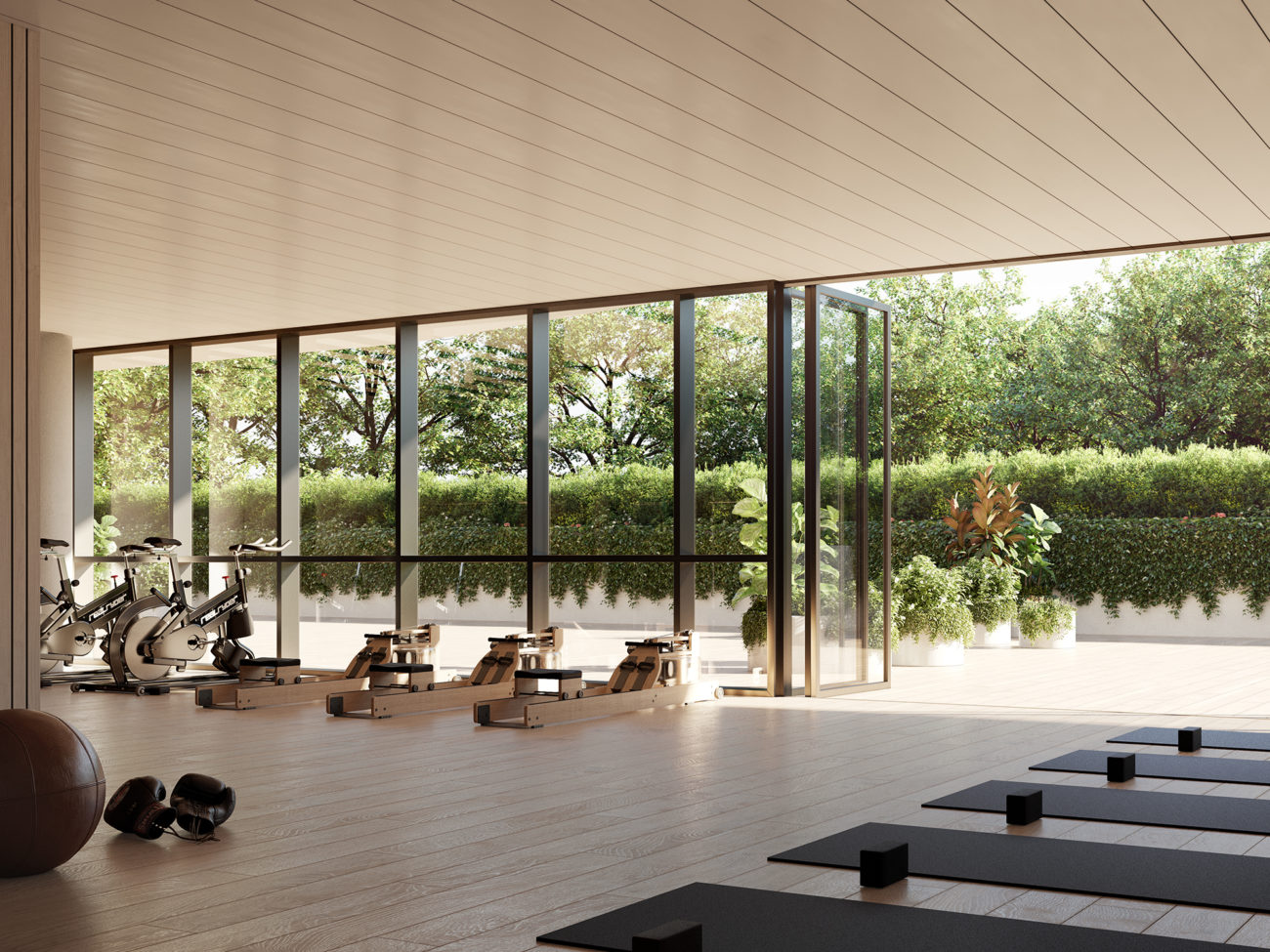
STPG WOVA Project CGI - Image of gym

Liviti’s Top Apartment Gym Features

  1. Rooftop

    An apartment gym perfectly positioned high up on the rooftop, rather than a basement, is a perfect way to allow residents to enjoy natural light and good sunset views. If your apartment is in a nice location, you’ll be able to soak in the sweeping city or water views whilst getting your exercise in.

    For investors, it’s also good to note that for most apartment buildings, a luxury rooftop gym can influence apartment rental prices significantly. A ground floor workout room doesn’t have as much of an impact.

  2. Good range of equipment

    A simple element, but super essential! The most important part of a gym is the equipment it has!

    An apartment gym with a cable machine, treadmill, stationary bike, a few benches and free weights ticks all the boxes. So if you’re a runner, lifter, or somewhere in-between, you’ve got all that you need.

Apartment Gym - Luxury

Luxury Apartment Gym

  1. Other cool amenities

An apartment gym complemented by other amenities such as spas, saunas or pools definitely turns heads. Some spaces even have wellness features, such as indoor gardens or yoga spaces for those who want to just chill out at the end of a long week. What a dream!

STPG - WOVA Project CGI image of pool

Benefits of a gym in your apartment building

No monthly membership fee

Yep, you don’t need to pay your standard gym monthly membership fee if your building has a gym. This is a great benefit if you’re buying your first apartment since you’ll probably have heaps of costs to cover and need to save up.

At a standard gym, once you sign up, you might be locked into a contract, meaning that it can be pretty difficult to cancel. But in an apartment, there’s no contract, and your gym costs are included in the fees you pay for access to other services in the apartment building. Sweet – you’re basically lifting for free!

Convenience

Having an apartment gym in the same building = convenience! No need to search for a gym or travel far lengths to get there, because you’re in the prime location – just minutes from your doorstep!

You don’t have to worry about ease of access, time management with your schedule or transportation costs. If you lack the motivation to work out – this extra convenience is a win!

Less people

Say goodbye to ‘bro hour’ – the notorious term for that peak time in the gym (mostly dominated by men), where all of the equipment disappears and you probably have to just use your own body weight. So if you can’t stand crowded spaces, or feel easily overwhelmed or claustrophobic, you might want to stay in your apartment building. In an apartment gym, you can enjoy a space with fewer people, so there’ll be more equipment to enjoy and no need to ask the guy next to you how many sets he has left.

Social Opportunity

Who doesn’t like making new friends? In a standard gym, you’re surrounded by people that you don’t know. But in an apartment gym, you’re sweating alongside people that live in the same building as you. This creates a perfect opportunity to strike up some friendships, or even find a partner to work out with you and boost the motivational energy!

(Source: Bruce Mars - Image of woman sitting on yoga mat with in front of girl)

Possible Increased Rental Return (For Investors)

Since they can use their apartment gym, tenants may cancel any existing gym membership. So investors can consider requesting a higher rent, compared to buildings without an on-site gym. This means that you can possibly get an increased rental return! If you like the sound of that, invest in an apartment with an on-site gym and you’re in business!

Gyms are the way to go

Whether you’re a fitness guru looking for your first apartment, or an investor searching for the best building perks, make sure it has a gym or fitness centre for all your lifestyle needs!

Contact Liviti at 9056 4311 or get in touch here if you need professional guidance on your property journey, or even just to get your foot through the door!

The Ultimate Apartment Interior Design Guide for 2022

So, you’ve just moved into a new apartment. Amazing! One problem. You’re ready to get the place looking lit but there are waaaaay too many interior design styles to choose from. What is the best way to turn your small apartment into a magazine-worthy abode or spice up your living room to really show off its quirky personality?

In this guide, we’ll share a few of our favourite design styles to give you decorating ideas and to inspire thoughts on how you can make your apartment look picture perfect with the right décor.

Whether you need general style ideas for your new apartment, are trying to create a focal point in a living space or want to find a unique statement piece to match your existing style, read on and answers ye shall receive!

Source: @apartments_developments. Victoria, Melbourne . https://www.instagram.com/p/CLkw65OBxPS/?igshid=YmMyMTA2M2Y=

What Common Interior Design Problems Do Apartment Dwellers Face?

Small Spaces

With the small square footage that some apartments have, it can be especially difficult to design the interior just how you’d like it. The good news is that there are PLENTY of ways around what seems to be a small space.

Not A Homely feel

Another hurdle that many apartment dwellers face is that the apartment tends to retain that sterile ‘rental feel’ after moving in and they’re just not sure how to style it into a home.

Source: @palm_interiors. Palm Beach, QLD. https://www.instagram.com/p/CdT5xdiBDr6/?igshid=YmMyMTA2M2Y=

Weird Angles

A small space, like in studio apartments, can be challenging to work with when it comes time to make your abode feel like a home. The apartment may have lots of weird angles and strange nooks and crannies, especially if it’s older.

Lack of Natural Light

Most modern apartments will take this into account by increasing the size of windows and facing the apartments in the most favourable direction to gain maximum sunlight throughout the day. Some older apartments, and even modern apartments positioned on shady sides of the building, don’t have that luxury.

https://www.instagram.com/p/CZZTnx-MrdZ/?igshid=YmMyMTA2M2Y=

Have hope though, there are ways around the problems listed above.

Our Top Interior Styles For Apartments With Limited Floor Space

Our number one tip for styling your apartment in 2022 is to choose colour wisely. It can be an incredibly useful tool and can bring life into a dull space.

For most of the following styles, white features heavily, especially white walls. This is because white can help brighten a room, not to mention it is a great base to amplify any style and colour choices you wish to incorporate into your home.

Whether you need to decorate your living rooms, the dining area, or are simply unsure what colour wall will suit a room best, keep reading for some solid advice from our design experts.

Contemporary Apartment Decorating Ideas

Let’s kick things off with contemporary design. Not to be confused with the modern design style, contemporary design consists of splashes of colour and different textures, as well as abstract décor and artworks, and feature walls. The main tones are often muted (whites, greys, and blacks), enhancing the different colours you may want to present in your home.

One current trend that’s circulating within the contemporary design style is ceramics and vases of all different shapes, such as arched or curved.

Source: @thirdaesthetic https://www.instagram.com/p/CO4Xk4kMZtt/?igshid=YmMyMTA2M2Y=

Minimalist (A Small Coffee Table Can Be a Massive Feature)

Similar to contemporary, in this style we see lots of grey, white, and black, with often only a very small splash of colour used as an accent.

In the ‘less is more’ fashion of minimalist style, there is a focus on more space by removing clutter and keeping the home tidy.

A classic minimalist designer trick used in areas of low natural lighting is installing slim floor lamps to create a natural light-style ambiance.

When looking to implement a minimalist style, functionality is key. Ensuring furniture is both practical and stylish is key, such as incorporating storage space for a few books and remotes in a quaint coffee table.

Source: @apartments_developments. South Melbourne https://www.instagram.com/p/Cd4dP_JPcwa/?igshid=YmMyMTA2M2Y=

Boho Vibes

Unlike contemporary and minimalist styles, the boho style consists of more natural and neutral base colours like browns.

Woods, rattan, cane, ceramics, and knotted wool are all coveted furniture pieces, shying away from the more ‘hippie’ theme with the addition of luxury-style furniture and décor.

Try styling your living space with a natural wooden coffee table, a beautiful ceramic vase, woven shades over pendant lights or decorative objects like vases or sculptures to make the space feel loved.

For homes that need a little extra ‘oomph’ in the style department, a ‘hybrid’ boho-coastal theme could be the perfect solution.

Coastal Themes To Cancel Out A Small Living Room Feel

The coastal style, in today’s day and age, isn’t necessarily ‘beachy’. It is breezy and bright; with ocean and sky influences, but not overly so. This style takes inspiration from more natural materials, such as wood, and features beautiful green and blue tones. Window treatments are often soft, flowing curtains so as to not obstruct breezes and natural light.

Relaxation, comfort and holidaying at home are what this style is all about. Woven rugs and pendant light shades, different tones of blue-greens, and timber furniture all pieced together create a warm, seaside vibe.

Popular decorating ideas for this style include large, shell-shaped bowls, woven trays and baskets, and photographic artwork.

https://www.instagram.com/p/CZUJyoXuI1B/

Mid-Century Modern Interior Design Style

Mid-century modern style is a present-day take on, well, mid-century design.

This theme covers decor spanning from the mid-1940s to the 1970s. It incorporates clean, simple lines that are carried by fixed properties, such as wall panels and splashbacks, and heavily features the use of timber in both paneling and furniture.

Vintage furniture is often the centre point of the room, including items like those made by Hans Wegner.

A large, overhanging floor lamp, colours such as green or mustard yellow and abstract wall art create a certain ‘wow’ factor.

Source: @threerooms_sydney. Elm timber https://www.instagram.com/p/CdXwie7MhaP/?igshid=YmMyMTA2M2Y=

New Industrial Apartment Style Trends Have Hit Australian Homes

The industrial style, like minimalist design, is heavily stripped-back. It truly shows off the ‘bare bones’ of the home. This is achieved by highlighting exposed beams or ceilings, polished concrete floors, brick walls, and even exposed piping! These features can easily make the room feel larger than it is.

The industrial style involves a lot of metal and leather furniture. Metal fixtures, even a metal coffee table or leather couches encapsulate this style. A play on colour can help make the house or apartment feel less cold when using lots of metal and leather, so a splash of red or yellow can go a long way. In the living room, for example, wall sconces and lamps can accentuate industrial features and really make them pop.

A ‘new wave’ of industrial styling is also emerging. For Australians, this style hasn’t been common due to the nature and build designs of our houses and apartments. A warmer type of industrial trend is beginning to grow – in some spaces, timber is also used but it is far more refined than that of other styles, plus indoor plants are making an appearance.

brown wooden dining table near white and brown mini bar

Scandinavian (For That Classic IKEA-Inspired Look)

Scandinavian style starts, first and foremost, with a white base and continues with splashes of black elements. Although the base colour scheme is monochromatic, a feeling of warmth can be obtained from décor choices.

Texture plays a large role in this style, so incorporating plants, fur, and wood to introduce a natural component is genius. Quite similar to the minimalist style, the focus is on clean spaces without clutter.

A gallery wall (lots of photos arranged together on a wall), marble décor, and a statement lighting piece on a high ceiling can bring a Scandinavian-style room to life.

Luxe Means Big, Bold and Glamourous

Splendour and elegance. Honey, if you ain’t got it, don’t try to pull off this style.

Colour is applied boldly and patterns feature prominently. Nothing but the best for this style with everything made of the highest quality and placed with precision.

Beautifully designed lighting and large mirrors add an element of grandeur. Furniture is often custom-made to fit the room perfectly, while carpets and joinery are eccentric and unique. Window treatments usually include plantation shutters and light, flowing curtains.

Furs, brass, and gold feature prominently to make rooms feel extra elegant and luxurious. Stone also features, especially unusual or rare pieces. The incorporation of a big dining table can make a luxe space feel even more extravagant.

Our Top 5 Interior Design Tips For Your Apartment

Now, we’ve spoken about different styles, but what are some easy apartment decorating ideas that you can do yourself that don’t cost a fortune? Whether you want something to spice up the living room or dining room, or you have limited space, here are our best design tips.

1. Shelving

Installing open shelves and bookcases is an excellent way to save space and display your décor.

Floating shelves are really cool and creative instalments in rentals that make it feel more like your own home and free up valuable floor space. When installed in a small living room space on an empty wall, swapping couch side tables out and just running with some cleverly placed shelving is a nifty alternative.

Source: @theshelvingshop . https://www.instagram.com/p/CJk2-j7lAIM/?igshid=YmMyMTA2M2Y=

2. Mirrors

Mirrors reflect light around the room, creating more brightness in areas that don’t get much natural light. By using large, tall mirrors against white walls, you can also add the illusion that the floor continues through the mirror, giving a larger apartment feel.

A large mirror paired with a white wall or a gallery wall featuring mirrors are both *chef’s kiss* stunning uses of this overlooked decor option.

Source: Katrina Lee Chambers. https://pin.it/hC94JiP

3. Multi-Use Areas

Repurposing an area for multiple uses can help save a lot of space. Transform your living room furniture to incorporate a desk, if you can’t have a dedicated office, or add a dining table into the living area for a living/dining room feel. You can easily create different zones that share a purpose within a small apartment.

gray fabric loveseat near brown wooden table

4. Low furniture

Installing furniture that appears low to the ground can have a super positive effect on your space. A low bed frame or couch can make it appear as if small spaces have tall ceilings. Coupling this with a hanging pendant light fixture will further accentuate the height of the ceiling and create an illusion of bigger space, especially in a small apartment.

Source: Apartments Developments. https://www.instagram.com/p/CcCft8lgj2-/?igshid=YmMyMTA2M2Y=

5. Storage

Built-ins (wardrobes) are a great way to maximise small space if you are able to add them to your home.

Building shelves into walls are an excellent storage solution and will help maximise storage and declutter an entire room. Hidden storage underneath beds or other furniture is also a genius way to open up the entire space of the room and keep clutter to a minimum.

Kitchen storage and organisation can give you some much-needed extra counter space, especially in a small apartment.

Our final tip is to try not to focus on too many rooms at once. Interior design can be overwhelming. Start with either the living room or kitchen and move on from there.

Home Storage

Minimalist Home Office Storage

We hope this has been an interesting read for you, and even if you didn’t find a style that tickles your fancy there will be something out there for you. You could even create your own style that’s never been done before and make it a thing. Why not? You do you!

You may never find a perfect example for your room style, so just do your best, make the most of the space you have and use whatever apartment decorating style suits your vibe. As long as your space feels homely to you, you’re on the right track.

Any questions or queries about who we are and what we do here at Liviti, feel free to get in touch.

What Happened to Davina’s $75 Million Listing on ‘Selling Sunset’

Netflix’s Reality real estate show ‘Selling Sunset’, Season 3 and all its glory came with its beautiful properties and suspenseful drama. 

However, do you recall Davina Potratz’s $75 million property? Wondering what happened, and if it’s sold yet? We were too! But first of all, let’s take a look back at this jaw-dropping property.

This property covers a whopping 1672 square metres of land. So you will definitely have more than enough room to unwind and relax. Talk about spacious living, privacy and personal space.

Davina Potratz's Property1

This modern mansion has a breathtaking interior with ambient lighting and spacious rooms. The dwelling of this vast property includes 7 bedrooms and 10 baths. Not to mention their very own separate guest house that has 2 bedrooms and 2 bathrooms. 

There is a perfect flow in the transition between indoor and outdoor living areas. Within the living areas, we can see a beautiful harmony between the kitchen, living and dining areas. The interior is elegant and lavish and is finished with a top-notch kitchen of course. 

Other features within the mansion of course include: 

  • Lavish owner’s suite
  • Walk-in closets
  • Movie theatre
  • GymWine cellar

Selling Sunset

It is also said this property has one of the biggest pools in all of Beverly Hills. Imagine taking a dip in this impressive pool any day, at any time, making this home the life of the party every summer.

Selling Sunset2

The backyard has luscious green grass areas and landscaping done – giving you enough space for when it comes to getting in your morning jog or getting a game of cricket going. Additionally, this outdoor area comes with an outdoor kitchen and dining area to relax and socialise in. 

Davina Potratz's $75 Million Property

Now the question that has been lingering in our minds. What happened to this property?

Well, it is actually still on the market! With the high price of $75 million in combination with COVID-19 lockdowns and restrictions, those with bigger budgets are not looking at the property market.  After all, $75 million is a very substantial amount of money to spend.

There was the previous talk of Davina speaking with a client trying to come to a mutual agreement for the listing. However, this was a year ago. Davina has since proven herself to owner of the home Adnan Sen by selling one of his properties for lease and redeeming herself and her reputation. 

Leaving the $75 million mansion property still up for grabs on the market.

Where Will Rihanna Raise Her New Baby Boy?

‘Bad gal Riri’, better known as Rihanna, is a Barbadian R&B singer, businesswoman and NEW MUM! Everyone has been raving about Rihanna’s baby boy and her relationship with rapper A$AP Rocky – but who didn’t know that? It’s Riri! 

But something you might not know is that Rihanna has one of the most IMPRESSIVE real estate portfolios. 

With Rihanna welcoming her first child and recently reaching BILLIONAIRE status, where will she be raising her family?

(Image: @badgalriri)

Rihanna the Property Investor 

Thanks to her widely popular Fenty makeup brand, Rihanna has become the world’s wealthiest female musician. She has definitely become the definition of ‘Girl Boss’. With that, and the continued success of her brand, Rihanna has made many smart property investments.

Over the years, she has owned, rented and sold several homes: 

1. Luxury New York Penthouse 

2. Mediterranean-style Mansion, Hollywood Hills, California

3. Beachfront Condo, Barbados

4. London Mansion 


5. Mansion in Pacific Palisades, California 


But these are just a FEW of the properties that Rihanna has called home. Her favourite is believed to be her most stunning home, which may be where she plans to raise the newborn baby. 

Rihanna’s Beverly Hills Farmhouse

Rihanna’s house in Beverly Hills is believed to be a strong contender to become the new home for her and A$AP Rocky’s new family. Last year, she even bought the house next door for $10 million. Could she be expanding for more babies to come?? We hope so!

Source: US Weekly - Image of Rihanna’s Farmhouse


The singer’s Beverly Hills Farmhouse is a $13.8 million dollar modern farmhouse, originally built in 1938. The 700 square metre home comes complete with a stunning custom pool, exterior and interior fireplaces and a cabana terrace. 

Source - US Weekly. Image of Rihanna’s custom pool


Its main suite has a huge walk-in wardrobe with black lacquer cabinetry, a luxurious marble bathroom and a terrace with sweeping views of the hills and mountains. With five bedrooms and seven bathrooms, Rihanna can raise many more children here! 


Source: Alexis Adam - Image of black lacquer cabinetry in custom closet

“I’ll have kids — three or four of ’em,” Rihanna said in an interview. 

Source: US Weekly. Image of spacious, marble bathroom

Rihanna sure knows how to score first-class living! There’s no reason why anyone wouldn’t want their baby growing up in a mansion like hers.

Since Rihanna gave birth to her baby boy in a Los Angeles Hospital on the 13th May, could living in Beverly Hills be on the cards? 

A Look Into Qantas CEO’s $19Million Mansion

Alan Joyce, the CEO of Qantas and his husband Shane Lloyd recently spent a whopping $19million on their new home.

Owning a $5million holiday house in Palm Beach and previously living in a penthouse at The Rocks, this couple is not a stranger to lavish living. 

Source: Domain.com

Their new home. A $19million, 15-room mansion! 

This three levelled mansion is located in Mosman and is a beautiful waterside residence. With direct access to the waterside and a jetty, this property can house a 7.6-metre long sailing boat. This is perfect, having the Sydney Amateur sailing club just across from the property.

Not to mention it also has a shark-netted pool! How cool is that?!

The mansion was built in 1908 but as of 2015 has been completely refurbished and redesigned by designer Paul Moon. Moon has made the overarching theme of the property as

A traditional Australian Federation Style house with a few American touches.

Leaving the property looking like a modern classic. This can be reflected throughout the 6 bedrooms and 4 bathrooms that this monstrosity of a property holds.

Inside the property are beautiful indoor living areas. The different shades of whites and creams make these areas pleasing to the eye. Besides the aesthetics, this mansion also has a home cinema, wine cellar and a double garage-making this space both fun and functional. What a dream!


Moving outside to the outdoor living areas, there is so much space to enjoy the sunlight and relax. With beautiful balconies and an even better view of the Sydney harbour, your morning tea is set to be more than relaxing.

Alan Joyce made a move in the ‘flight’ direction, as this Mosman mansion is nothing less than impressive.

What is the Best Apartment Floor to Live On?

Apartment Levels

So, you’re on the hunt for your dream apartment. You’ve thought about location, proximity to schools, public transport, and the energy of the neighbourhood. BUT – have you thought about which level you should live on?

It may all come down to personal preference, but before you secure your next apartment, you should consider the perks of each apartment floor.

READ ON to discover the ins and outs of each apartment level!

Giving your furry friends or the kids a real treat with space in a ground floor apartment

If you’ve got an energetic cavalier, or young kids, you’re probably keen for an apartment that has prime space. Luckily, a ground floor apartment provides just that!

Ground floor apartments usually come with a private garden or courtyard, perfect for cooking up a barbecue for guests and letting your children and pets run around (don’t forget to get approval from strata for your pets). These outdoor spaces are usually larger than balconies, and they almost act as an extra room. So you get more room for entertainment, loads of fresh air, and great space for pet owners and parents – woohoo!

Hey, but there’s more!

1. No Stairs

A ground floor apartment generally has fewer or no stairs at all – YES, your grocery hauls just got ten times easier. Fewer stairs also allow for an effortless move in and cater for less mobile or elderly relatives. Plus, in case of an emergency evacuation – you’re the first one out!

2. No neighbours below

Gone are the days of worrying whether you are bothering your downstairs tenants – because there are none! On the ground floor, your kids can play, stomp and run around freely.

3. Cooler temperatures

Who doesn’t like saving money? Since heat rises, ground floor apartments enjoy cooler temperatures in the summer months, meaning you can save energy costs on air conditioning or fans.

Apartment Floor

For those living alone or looking to rent a place that doesn’t need a courtyard or patio, ground floor units may not be for you. If you prefer to have good views, lots of sunlight and warmer temperatures, why not level up and score a top floor apartment?

Living the high life in a Top Floor Apartment!

Yep, if there’s any home that just screams wealth and class, it’s a penthouse. We all swoon over top floor apartments, maybe because we want to enjoy the view, or maybe above others… But if you’ve seen Kim Kardashian’s former New York Penthouse, you’d want one too.

Apartment Floor

Let’s talk about the highlight of top floor apartments – the views. If your apartment is near the city or water, the top floor will undoubtedly score the best views. Not only will you be able to host the prettiest cocktail parties, but you’ll be able to attract premium selling prices if you decide to move! The icing on the cake is, of course, the balcony to enjoy the view.

More pros include:

1. More security & privacy

Top floor apartments are usually positioned further away from the street, with windows that are not accessible from the outside. If safety is a top concern, you’re good up here!

2. Light, light & more light

Who doesn’t love more natural light? You’ll be warm and cozy in those cooler months in a top floor apartment with more exposure to light and rising heat. This is important in inner-city areas, where tall buildings overshadow others. Thankfully, you can save energy costs by using less heating and enjoying the natural light flooding into your living spaces.

3. Less noise

Living at the top means you’re far from street noise and vehicle traffic noise. The volume from underlying neighbours is minimal and there’s no-one above you either. You can sing in the shower as loud as you want!

Apartment Floor

If you don’t want to work up a sweat with long flights of stairs, or endure the warmth of the top floor, this may not be your personal choice.

Hauling a bike, groceries or going to greet guests or delivery partners can become a challenge from the top floor (depending on the video intercom available), so why not consider going for a middle-level apartment instead?

Don’t forget what’s in between – The Middle Level Apartment Floors

So, you’ve thought of living on the first floor and the top floor – but what about the middle? Much like the best part of a sandwich, the middle floor is a prime level in apartments. It offers the best of both worlds and has heaps of benefits to consider!

Life in the middle is a big win for your energy bills. Without air conditioning and heating, the higher floor tends to be challenging to cool down during summer, and the ground floor is difficult to heat up during winter. So being in the middle means your bills are more consistent, and you won’t have to worry about up and down temperatures!

Apartment Floor

Other perks include:

1. Lovely views

Living on the middle level still offers better views than a ground floor apartment! You can enjoy your views from the balcony, and probably for a lower price than a top floor unit.

2. Easy access

You may still get a workout from the stairs (if you’re not opting for the lift), but there will be less to worry about compared to living on the top floors. And the best thing is – there’s less wait time for lifts too!

Other things to consider

Before deciding your apartment floor you should live on, there are loads of other things to think about! At the end of the day, you want to pick an apartment complex that suits YOU (or your tenants) and fits your unique flair and lifestyle.

1. Price

Check the purchase price that comes with the apartment floor. Top floors usually come with higher prices, and the first floor may mean more bills for heating. You could stick to the middle levels if you want consistent billing prices.

2. Proximity

Is your apartment floor close to any laundry rooms or shared spaces, such as a pool or gym? Does your apartment complex have communal spaces or barbecue areas that you want to be close to? Check the proximity of your floor to amenities – if you want to be close to them (or far!) make sure you pick the right level! If you have less mobile friends or relatives consider the accessibility of your floor from the entrance.

3. Location

Probably one of the most important things to consider before you buy! Do you have children who need to be able to walk or catch the train to school? What about proximity to parks and shops for your daily needs? You don’t want to be too close to noisy street areas, nightclubs or dining precincts either. Don’t forget to consider where the apartment itself is situated.

Discover more on The Pros & Cons Of Apartment Living In Australia

What does our team say?

We’ve asked our team at Liviti which apartment floor they prefer and why!

Here is what we found:

“Top floor, for more privacy, less noise, good views, and perfect sunlight. Even facing south gives good neutral light” – Kevin

“Ground floor – dual entry point from the courtyard and your front door” – Jeremy

“My ideal choice would be Top Floor. I would enjoy the natural light received in a top floor apartment and the beautiful outlook over the district and possibly even towards the bay or city. Often Top Floor Apartments come with a higher price tag, in which case I would then opt for a Middle level apartment on a higher level. This would still give me amazing light and views.” – Lara

“My dream apartment would definitely be from the middle level up with a lot of glass to maximise the views. There is something about living up high with great views that always make me feel so relaxed, especially if it’s a city view at night time. And yes, for me, views is the most important feature!!” – Lucy

So before you secure the deal on your next unit, think about which floor you want to live on!

Contact Liviti today for more helpful property tips and news, or to find, fund, buy and live in your new apartment!

Alicia Xiberras’s Apartment Living Tips and Tricks

We all know that a well-lit apartment is hard to find. So if you own an already well-styled apartment, CONGRATULATIONS, you are already ahead of the game!

But for everyone else who is still struggling to make the most out of your apartment living, you might have to employ some clever tips and tricks. Which should be easy because we have already done all the homework for you.

We interviewed renowned Australian Interior Designer, Alicia Xiberras on the art of  “acing apartment living!”.

Alicia is the Director of Alicia Xiberras Interiors (AXI), a female powerhouse of Interior Designers brought together by their passion to create beautiful spaces and interiors.

Recognised as one of Australia’s most upcoming and promising designers, Alicia Xiberras Interiors offers a fresh, innovative and exciting take on a wide variety of design needs for both residential and commercial spaces. With over 15 years in the design industry, AXI is dedicated to helping you achieve your dream space, inspired by the latest design trends and catered to any design style.

Design Ideas with Alicia Xiberras - Interior Designer

And now, we are about to break our interview down for you in 3 … 2 …

1. What’s the biggest mistake people make when styling their apartment?

“The biggest mistake apartment owners tend to make is that they don’t focus on the scale of furniture in accordance to their room size.”

Designer Tip: Small Apartment’s don’t always = small furniture

Ensure you are using the right sized furniture to fill your space without making it feel cramped.

Think about your living space, if you value comfort, opt for a decent sized lounge and smaller storage space. If you value storage, opt for a smaller lounge and better storage options.

2. The second mistake to avoid

“Another mistake apartment owners are guilty of is trying to introduce a style in their space that doesn’t look accurate. When it comes to executing certain interior design styles, they require large spaces.

Designer Tip: “It’s important to understand that the style you’re intending to use works with the space.”     

3. We always hear the saying, ‘Bring the outside in’, But should we really?

“Today’s society very much craves the concept of “bringing the outside in”, especially in apartment living.

With COVID lockdowns impacting people’s perception of being outside, it’s important to ensure your apartment has qualities that can give the illusion of this concept.”

Designer Tip: Start by slowly adding some plants to your décor. Whether real or fake is up to you – *We don’t have a green thumb to keep plants alive either!*

4. What should I do if my apartment feels small?

“Consider natural light and the treatments on your current windows!”

“Also consider your flooring and wall colours. When a space feels small, a light colour palette and lots of natural light is a great psychological tool to assist with this issue.”

5. What are your top 5 design tips to ace apartment living?

“We recently designed an apartment in the heart of the Sydney CBD district, the project was called Australian indulgence. When we designed this apartment for our clients it was fundamental we considered these topics, to achieve the perfect apartment lifestyle for our clients.” said Alicia.

Let’s find out what Alicia’s Top 5 tips to acing apartment living are and trust us, You will want to TAKE NOTES!

Noise/ outside noise

“This is fundamental with apartment living as it can impact your wellness and sleep cycles.”

*We get it, no one wants to be woken up by the garbage truck at 4am or kept up every Friday night by the Pub across the street*

“Consider acoustics, like rugs or fabric furnishings within your apartment to collect any excess sound. “

Alicia Xiberras Interiors - Consider acoustics. Add Rugs or fabric furnishings to your living space

Natural light – How much do you really want?

“Bring the outside in and don’t be afraid to consider window furnishings that allow complete sunlight to saturate the apartment. It’s still important to also ensure that you can still have complete privacy or block out.”

Designer Tip: “A double roller blind, with block out & sheers overlaying will be the ideal selection for apartment living.”

Alicia Xiberras Interiors - How much light do you want in your apartment? Make the space feel larger with light

Furniture size

“If you are concerned with working with a tight or small space, always consider the scale of furniture in the room.”

For example, “if you have circulation issues, instead of a rectangle dining table top, consider an oval top, this allows a softer curve and further circulation around your dining table.”

Alicia Xiberras Interiors - Furniture size can make a room feel small or can make rooms feel larger

Accessorising

“I avoid over accessorising in styling and décor. This can make the apartment feel cluttered and overdone.”

Designer Tip: “Remember that old fashion quote ‘less is more’!”

Alicia Xiberras Interiors - Apartment Design Ideas

Colour pallets

“Avoid loud and dark colour pallets when the space is small!”

*Does anyone remember Matt & Kim’s ‘Panic Room’ from The Block 2013? – You don’t want to, what a nightmare! *

Matt & Kim's 'Panic Room' from The Block 2013 - Creating crazy walls

6. What’s your number 1 tip for those styling their apartment on a budget?

(And what they should splurge or save on!)

Save

“I think the best place to look at when sourcing furniture on a budget is Ikea or Facebook marketplace.”

Remember the saying: ‘One man’s trash is another man’s treasure!’ – It’s becoming even more true.

Splurge

“I would splurge on a decent lounge and mattress, when it comes to ergonomics in a living environment, never take shortcuts!”

Designer Tip: Comfort always wins in a living and bedroom!

Save

“In terms of Décor sourcing, always go to Kmart. They have great basics and have a decent selection when it comes to different styles.”

Did you hear that! Alicia Xiberras just gave us permission to Splurge in KMART.
So when your partner asks why you spent so much at Kmart, just show them this article 😛

Save- DIY

“Don’t be afraid to make things yourself! Pinterest is a great place to generate ideas. Whether it’s finding gorgeous dried tree branches in the park, shells at the beach or pebbles in the garden, the possibilities are endless.”


Okay! So Alicia has spilt the tea. It’s your turn to make the most out of your apartment. We’re excited to see you snag that place of your dreams!

Cash Flow or Gearing? Growth or yield? Understanding Property Investment Terminology

When it comes to property investment, questions like, “Which is better, positive vs negative gearing?” or “Should I go for yield or growth?” is kind of like asking, “Which is better, a hammer or a screwdriver if I want to mow the windows?”

Firstly, let’s start with understanding gearing.

Put simply, ‘Gearing’ means using borrowed funds. Investors typically ‘gear’ their investment properties because buying property for cash is really, really, really hard for ordinary Australians – even for those on incomes well above average.

If you know anyone with a mortgage, they have used gearing. If the property is their home, the gearing has no tax implications. If the property is an investment, the gearing will have tax implications.

So why use borrowed money or ‘gearing’ to buy a property? Why not just save up the money required and pay cash?

Imagine a 100m race between a bicycle and a Tesla. The bicycle represents the speed at which most Australians can genuinely save money and the Tesla is the increasing purchase price of an average property in the Australian market. Unless the Tesla has its wheels removed, the bicycle doesn’t stand a chance. And so it is with the ability for most Australians to save money quicker than property prices are rising. The majority of property buyers need a super quick injection of funding (borrowed money) to complete the purchase or they will never catch the market.

So now we know what gearing is, what is all the talk about positive and negative gearing? Is one better than the other and which is best for you?

So, What Is Negative Gearing?

Let’s apply a basic bookkeeping idea – debits on the left and credits on the right.

In simple terms, an investment property is negatively geared when the debits (you could also call them costs or expenses including interest, maintenance, insurance, strata, council rates and depreciation) are bigger than the credits (usually called rent or rental income). That is, more money is going out per year than is coming in.

Just like with any business, when more money is going out than is coming in, the business is making a loss. The difference when it comes to personal property investment, however, is what can the loss be used for and what does the ATO permit on your personal tax return.

So, in this case, the ATO will permit the property investment loss to be deducted from the annual income of the investor *YES!!

Let’s explore further using basic numbers – Meet Billy!

Billy is a worker in a local factory. He earns $100,000 annually for this job.

His investment property has a rental income of $20,000 and expenses of $30,000 for the financial year therefore Bill’s investment property makes a $10,000 loss. The $10,000 loss is then able to be deducted from Bill’s factory wage.

So, Bill will pay tax on $90,000 income not $100,000.

Benefits of Negatively Geared Property Investment

Capital Growth

Properties purchased for negative gearing outcomes generally show great potential for capital growth, with the end goal being impressive gains received upon the sale of the home.

As long as the property shows high potential for future growth and quality research has been carried out to prove this, capital gains should outweigh any losses incurred by a long shot.

Long Term Tenants

Properties with the potential to successfully negatively gear are often located in areas with low rent and high vacancy rates. Finding long term tenants in these kinds of areas isn’t usually too difficult, so if you find a good renter, they may be with you for the entire life cycle of the property which is a huge plus and means less stress for you, as the property investor.

Drawbacks of Negative Gearing

Potential For Negative Cash Flow

When purchasing a negatively geared investment property, it is advisable to ensure you have a stable income that is likely to increase over time. By ensuring this, you can cover any property expenses that may be incurred where rental income doesn’t cover.

Capital Gains Attract Tax

Keep in mind that 50% of your capital gains will attract tax. It’s important to take this into account when considering a property purchase based on negative gearing.

What is Positive Gearing?

You’ll often find positively geared investments referred to as cash flow positive properties.

A positively geared investment is entered into with the understanding that the property will attract high rental income and produce more cash flow from tenants throughout the life span of the ownership.

Essentially, the positive cash flow from rental income on these types of investment properties is expected to cover property prices and fees, while generating passive income for the homeowner.

Think of a property located close to a city where vacancy rates are low.

This may put you in a position to charge $600 per week in rent. Say the overall costs of owning the property average out to be around $550 per week.

This means your property investing strategy is immediately paying off, leaving you with a net return on investment of $50 per week.

And while your ‘business’ is making a profit, we need to consider the ATO’s rules to complete the picture. For a positively geared property, the ATO will add the investment ‘profit’ to the investors existing taxable income.

Now, meet Mary!

Just like Billy, Mary also earns $100,000 working in a local office.

Her investment property has a rental income of $30,000 and expenses of $20,000 for the financial year therefore Mary’s investment property makes a $10,000 profit. The $10,000 profit (considered taxable income) is then assessed in addition to Mary’s factory wage.

So, Mary will pay tax on $110,000 not $100,000.

How Does Positive Gearing Work with An Investment Property?

As mentioned previously, the ultimate goal of owning positively geared investment properties is to gain positive cash flow that will not only cover the expenses of the investment property itself but also provide a source of passive income for the owner.

The goal of this investment strategy is to gain wealth and stability, which is in line with investors who choose the negative gearing approach. It’s just a different way of going about it.

Rather than seeing high capital growth and selling when the time is right, investors focus on gaining income while the property is in their hands when negative gearing is the chosen strategy.

Essentially, they want to make sure they’re seeing a return on their investment throughout their entire ownership, not just at the end.

Benefits Of Positively Geared Property Investment

More Cash Flow

Though a property focused on positive gearing may see lower capital growth overall than one designed to negatively gear, the major plus is that you can use your own home from the get-go as a source of additional income.

You’ll see the fruits of your labour upfront as you receive rental payments from tenants that cover not only your maintenance costs, mortgage fees, interest payments and other expenses, but will also provide extra cash for you to invest, set aside as savings or spend as you see fit.

Increase Your Borrowing Power

Properties that aim for positive gearing outcomes tend to be considered a little less risky than ones with negative gearing goals, simply because the income received throughout the ownership is greater than the expenses incurred.

This can ultimately set you up with more borrowing power should you wish to expand your investment portfolio.

Versatile Option for New And Old Investors

Positively geared properties are highly attractive investment opportunities for both seasoned and rookie investors alike.

New investors can begin their portfolio with a property that offers less risk or financial burden until the eventual sale.

Established investors with an existing property that is positively geared have seen/are seeing the benefits first-hand, and will likely choose to grow their portfolio with similar properties.

Cover Losses of Your Negatively Geared Properties

If you do decide that you’d like to try your hand at owning a negatively geared property, you can utilise the income from your existing properties built around positive gearing to cover any losses incurred so you’re not left out of pocket.

Drawbacks Of Positive Gearing

Your Rental Income Will Be Taxed

Yep, income from rent is taxable income so the ATO is going to want their share of your rental income as you receive it. Be sure to incorporate this into your tax payable calculations when deciding whether to go ahead with your investment.

Fluctuating Or Slow Capital Growth

The majority of properties with positive gearing benefits tend to be located in or near rural or regional towns, which can often affect the capital growth of an investment. This may take a toll on your ability to access equity to fund other prospective investments.

Low Rental Yields Can Negatively Impact Your Cash Flow

As mentioned above, one of the major benefits of positive gearing is positive cash flow. This can be negatively affected by low rental yields, depending on the state of the property market and other economic and social factors.

What about Neutral Gearing?

Yes, if you’re wondering is there a “neutral” gearing option, there is!

This concept happens where the amount of money going out per year is the same as the amount of money coming in – enough rent is received over twelve months to exactly cover the full cost of all the outgoings.

But, this usually doesn’t happen naturally and probably requires some creative accounting to make happen year on year on year.

Neutral gearing is more likely to be found in the space surrounding seasoned property investors with multiple property investments; whom by default have more moving parts than first-time investors. This will generally allow accountants more wriggle room to ‘carry the one’.

Looking at the numbers for your investment strategy

Okay! But what has positive or negative gearing got to do with hammers and screwdrivers?

Positive gearing and negative gearing should be considered separate tools available to investors to assist with certain investment (tax) outcomes. Positive and negative gearing can also be used to create opportunities that otherwise might have remained out of reach.

Just like there is no perfect approach to renovating, there is no one investment gearing tool that does all jobs. Much will depend on many varying factors.

If Mary’s goal is to reduce the amount of personal tax she pays, her positively geared property isn’t helping her.

If Bill is struggling with cash flow and generally finding it hard to make ends meet, his negatively geared property isn’t helping him (since now he needs to personally fund the $10,000 loss: $200 per week out of his own pocket).

Then Which Is Better, Positive or Negative Gearing?

The end goals of both positive gearing and negative gearing investment strategies are very similar: to gain wealth and stability through well-researched property investment opportunities.

As with all property investment, it is important to weigh up the different factors like overall taxable income, the depreciation schedule of the property, any tax benefit that may be afforded, any tax deductions that may come into play, as well as interest rates and more.

It’s always best to seek independent financial advice on any investment you plan to make but essentially, when it comes to negative and positive gearing, those investors with a steady income stream that is likely to increase could consider negative gearing as a quality investment, while investors who prefer an opportunity that will provide positive cash flow throughout the ownership could benefit from a positively geared property.

keys on hand

All in all..

If you’re interested in finding out more about positive and negative gearing or property investments in general, please don’t hesitate to reach out to our team of experienced and highly skilled real estate experts.

We can help you find the positively geared property, as well as negatively geared opportunities to suit your specific circumstances.

Pick up the phone and call (02) 9056 4311 for a friendly chat today!

If gathering info online is more your style, we’ve got a contact form where you can send us a message.

The Pros & Cons Of Apartment Living In Australia

Population growth in Aussie cities across the country is growing rapidly, and housing prices are constantly shifting. It is becoming increasingly difficult for house hunters of all styles and backgrounds to purchase a home in the current climate while finding a property that ticks all the right boxes.

Due to the demand for city dwellings, there has been an increase in apartment developments meeting the needs of many buyers, as well as budgets. So, what’s there to know about apartment living in Australia before investing in the keys to the front door? Let’s find out!

What Is An Apartment?

Ok, this sounds like a silly question, but humour us for a second. Let’s make sure we’re all on the same page when it comes to the defining qualities of apartments.

An apartment, which we also refer to as a unit in Australia, is generally defined as part of a building that is a self-contained living space. Apartments are normally in blocks or complexes, with some offering more than 40 residences, contained over multiple stories. They will often have communal areas like grassy picnic zones for kids and families to explore, gyms and pools for fitness junkies and even pet care facilities in more recent developments that complement new laws surrounding pets and strata laws (YAY!).

brown tabby cat lying on gray couch

Units can range in size from studio, a single space that hosts the bed, kitchen table and facilities and lounge room of the people living there, to 5+ bedroom penthouse suites with their own private pool. Depending on a buyer’s financial situation, a range of options can be readily available to them and suit their individual lifestyle needs or the needs of their family.

How Many Australians Live in Apartment Complexes?

From 1991 until the Australian 2016 census, the number of apartments occupied by Australians has increased by 78%. According to the same census, approximately 10% of Australians spent census night within an apartment at that point in time (with 95% of these in their usual apartment home). That is a whopping 2 million (approx.) people.

Through that census data, the Australian Bureau of Statistics also found that occupied apartments are increasing from one for every seven houses in 1991, to one for every five houses occupied in 2016.

The growth we’ve seen tends to happen within urban settings, meaning that a good majority of apartments are in close proximity to a capital city and its centre.

What Type of People Choose ‘The Apartment Life’ in Australia?

The data from the 2016 Census reported that the main age of those living within an apartment was around 33 years old. It was also found that the numbers were slightly more skewed towards females (51%) as opposed to males (49%).

Unsurprisingly, the study concluded that more of the younger generation are opting for apartment living. The reasons for this vary from apartments being a cheaper option to a preference for units over houses due to lower maintenance, but it’s not uncommon nowadays to see many young families living in an apartment rather than a house.

Free Girl Playing Inside Her Room Stock Photo

How to Ace Apartment Living

We interviewed renowned Australian Interior Designer, Alicia Xiberras on the art of “acing apartment living!”. Alicia is the Director of AXI, a female powerhouse of Interior Designers with over 15 years experience in residential and commercial spaces.

Alicia Xiberras - Interior Designer

We asked Alicia, ‘What are your top 5 design tips to ace apartment living?’.

“We recently designed an apartment in the heart of the Sydney CBD district, the project was called Australian indulgence. When we designed this apartment for our clients it was fundamental we considered these topics, to achieve the perfect apartment lifestyle for our clients.” said Alicia.

Let’s find out what Alicia’s Top 5 tips to acing apartment living.

*You will want to TAKE NOTES!*

Take Notice of Noise

“This is fundamental with apartment living as it can impact your wellness and sleep cycles.”

*No one wants to be woken up by the sound of a truck going down the highway at 4am*

“Consider acoustics, like rugs or fabric furnishings within your apartment to collect any excess sound. ”

Alicia Xiberras Interiors - Consider acoustics. Add Rugs or fabric furnishings!

Natural light – How much do you really want?

“Bring the outside in and don’t be afraid to consider window furnishings that allow complete sunlight to saturate the apartment. Its still important to also ensure that you can still have complete privacy or block out.”

Designer Tip: “A double roller blind, with block out & sheers overlaying will be an ideal selection for apartment living.”

Alicia Xiberras Interiors - How much light do you want in your apartment?

Furniture size can impact how the space feels

“If you are concerned with working with a tight or small space, always consider the scale of furniture in the room.”

For example, “if you have circulation issues, instead of a rectangle dining table top, consider an oval top, this allows a softer curve and further circulation around your dining table.”

Alicia Xiberras Interiors - Furniture size can impact how the space feels

Accessorizing

“I avoid over accessorizing in styling and décor. This can make the apartment feel cluttered and overdone.”

Designer Tip: “Remember that old fashion quote ‘less is more’!”

Alicia Xiberras Interiors - Styling tips

Colour pallets

“Avoid loud and dark colour pallets when the space is small!”

*Does anyone remember Matt & Kim’s ‘Panic Room’ from The Block 2013? – You don’t want to, what a nightmare! *

Matt-and-Kims-Panic-Room-The-Block

Source: Channel Nine

Designer Tip: “Remember to work with your space and not compete with it.”

Want to check out some of Alicia Xiberras’ work? Head to her website, you won’t be disappointed!

Alicia Xiberras Interiors - How to Ace Apartment Living?

Apartment Living Pros & Cons

The apartment lifestyle isn’t for everyone, but it certainly does have some great benefits. If we can provide one piece of advice to future apartment owners, it is that versatility and convenience are absolutely key when looking at the benefits of a particular apartment, and its location.

Pros for Apartment Residents

Free Side view full body barefoot young bearded male in casual clothes standing against window and lifting laughing girlfriend up during relocation and unpacking things from cardboard boxes Stock Photo

1. Affordability

A major plus in terms of apartment living is the cost to purchase. For first home buyers, a $500,000+ price tag on a house can be super daunting and often seem entirely out of reach. It’s a struggle, we get it. Wages aren’t on the rise, but house prices are #gofigure. Here’s where apartments provide a solution.

According to Canstar, apartments are priced at almost $200,000 less than median house prices which are approximately $800,000 in capital cities. This makes them much more affordable for both first home buyers and those looking to expand their existing portfolios.

Units and apartments are a fantastic way for new investors to break into the property market, considering how much they will be saving. Making a solid investment just became much easier to afford.

It also tends to be easier to find tenants to rent out to, if the property is in a good location (most units are based in or around capital cities), plus there are fewer costs associated with the upkeep of a unit as opposed to other property types.

pink and black ceramic piggy bank

2. Access to Shared Facilities & Amenities

Many complexes, especially those in high-rise buildings, often come standard with facilities such as a pool, gym, and even outdoor communal areas like small parks for entertaining family and friends and for letting the kids run wild and free. Want an excuse to meet the neighbours? Hang out in the communal spaces every so often and you’re sure to pick up some new acquaintances.

On top of this, gym memberships, for example, can cost upwards of $100 per month. With a gym on-site and available for residents to use without additional fees attached, that 100 dollarydoos can go towards buying an extra pack of protein powder or, like, 150 potatoes for carb loading. Think of the gains, people!

exercise equipments inside a room

3. Insurance Savings

Apartment living is a sure-fire way to save money on home insurance. Often house/building insurance is paid for by body corporate fees, meaning that the resident only has to pay for insurance on their contents within the apartment, such as furniture and electronics.

4. Less Maintenance

One of the main reasons people live in apartments is the fact that they generally require less maintenance than a house.

Apartment complex amenities like a communal outdoor space and even the building itself are generally cared for through the strata body or the landlord, meaning that the resident need not fret about having to mow the lawns or clean the gutters.

A comparatively small space for living in can also be a benefit in regards to household maintenance, as less space means less cleaning. I think we can all get around that!

5. Exciting Lifestyle

Because a lot of apartments are based in areas close to cities or areas with lots of attractions or business precincts, you can generally expect to be close to public transport and other super convenient amenities. This can help reduce living and travel expenses, while also providing a lifestyle full of excitement, fun and good food which is usually high up on the ‘must-have’ list when it comes to buying a home.

6. Convenient Location

A great location close to the city is often the biggest drawcard when people consider apartment living. For many Australians, buying or renting an apartment means they can live in close proximity to a city and all its attractions at a much more affordable price. The city is practically their backyard to explore!

city skyline during night time

7. Security & Peace of Mind

Apartment buildings tend to have extra security when compared to other properties. Nine times out of ten, buildings will have a communal entry area that is locked for resident-only access, and many new developments come equipped with surveillance cameras, secure parking and security doors.

With neighbours close by and above ground level units difficult to reach, it is much riskier for criminals to attempt an apartment break-in, as opposed to entering a house. Apartments located in more extravagant buildings may also have a security guard present on site.

For families with young children and, honestly, anyone who isn’t a fan of dealing with break-ins (most people, we assume), living in a unit can provide some serious peace of mind, in that sense.

8. Sustainability

Think about it; less air conditioning usage due to smaller spaces, fewer living areas to fill with furniture that will eventually end up in landfills and a whole other slew of aspects that help old Mother Nature live her best life.

Living in an apartment opens the possibility of a sustainable lifestyle much more than living in a house or larger property.

Cons of Becoming Apartment Dwellers

empty spiral staircase near white wooden door

1. Space Can Be Limited

While apartments are cute and cosy, they often have limited space when compared to other types of residences. Many apartments are often compact, which can be a slight drawback for those with a large family who need more space and lots of storage.

Also, some smaller and older apartments may not have room for an internal laundry, meaning the resident must use external laundry facilities provided on-site or at a laundromat or dry cleaner.

Families can often find apartment living difficult due to the limited areas for children and lack of private backyard space. If you love a balcony view, you’ll enjoy living in an apartment, but if you need a backyard for kids or pets, it may not be the best option.

2. Noise & Privacy

It’s no secret that the high-density housing situation of apartment design can often affect privacy. In some complexes, the balcony areas of each apartment may be close together, and any communal space, such as the pool, will have to be shared with neighbours who live within the building.

Noise may also pose an issue, especially for apartments located close to the inner city. Sounds from the street can filter into a unit from below, while the struggles of neighbours fumbling for their front door keys or hosting gatherings in a small apartment can prove to be an annoyance as well.

3. Parking Availability

cars parked in parking lot

Unlike houses with private garages and driveways, apartments can often limit the ability of residents to park nearby. It is quite common for high-density apartment buildings to have limited parking and in some buildings, private car parks don’t come standard with the purchase of the unit.

Those residing within large complexes often have to seek paid secure parking away from the apartment, or turn to street parking which comes with its own risks.

Sure, the complex may offer communal parking spaces on-site, but there’s no guarantee that Larry from across the hall isn’t going to drive in just before you make it home and take the last available spot. Classic Larry, amirite?

4. Strata Fees & Restrictions

Apartment living can be a little more restrictive than residing in a house. Any changes to the external area of the unit are subject to body corporate approval, as well as potential restrictions on noise levels, the ability to have pets within the building, and the use of the shared facilities.

In some cases, there may be ongoing costs associated with the general upkeep of the building and the communal areas.

5. Lower Potential for Renovations

2 person wearing blue denim jeans

Thinking more about the future of the property, it is far less likely a resident would be able to carry out major renovations on an apartment than a house.

Firstly, the body corporate of the building must be made aware of any planned changes to the external area of the home, as noise from construction could upset the neighbours.

It can also be difficult to change internal fixtures and the floorplan layout within an apartment, as ceilings and walls are considered a shared space, whilst plumbing is a huge pain to access and move around.

How to Access Home Loan Options When Buying an Apartment

The home loan process when purchasing an apartment is much the same as that of purchasing a house.

A property expert like those in our team at Liviti can often provide much-needed assistance throughout this process. It’s important to have the right people on your side when discussing home loans as some banks may not be willing to lend, depending on the size of the apartment and the location when compared to a buyer’s circumstances.

How to Buy an Apartment in Australia?

At Liviti, we have quality information and research right at our fingertips, allowing us to offer advice that leads to informed and clever decision-making surrounding the purchase of an apartment.

Aside from that, carrying out your own research online usually won’t hurt and can help ensure that the loan option you choose is perfect for you and your financial situation.

Whether you’re after a studio living space or an apartment with a little more room for families, we’ve got you completely covered! Check out our current listings and come chat with us if any tickle your fancy.