An investment property buyers agent is a licensed professional who sources, analyses, and negotiates property purchases on behalf of the buyer, working exclusively for you rather than the vendor. Here is what that actually means day to day:
- They find properties the public market never sees
- They assess deals through an investment lens, not emotion
- They negotiate purchase price and contract terms on your behalf
- They shortlist properties based on yield, growth, and your strategy
- They protect you from the decision fatigue that drives most bad purchases
If you have been wondering whether an investment buyers agent is worth the fee, what follows covers exactly what they do and where that value is most concentrated.
TL;DR
A buyers agent for investment property manages the entire acquisition process for you, from sourcing through to settlement. They work exclusively for buyers, which means their incentives are aligned with yours rather than the vendor’s. The most significant value they add is access to off-market and pre-market properties. According to the Real Estate Buyers Agents Association of Australia, as of October 2025, annual sales activity had increased nearly 3% while total listed stock was down nearly 15%, making off-market access increasingly important for investors who want quality assets in competitive markets.
1. They source off-market properties you would never find on your own
Most investors shop on realestate.com.au and Domain. Those portals show what vendors and agents have decided to list publicly, which is a subset of what is actually changing hands.
A significant proportion of investment-grade properties sell before they ever reach a public listing. These include pre-market sales where an agent tests the price with their buyer network before going to full public campaign, genuine off-market sales where the vendor does not want public exposure, and portfolio sales where a developer or landlord is moving multiple properties in a private transaction.
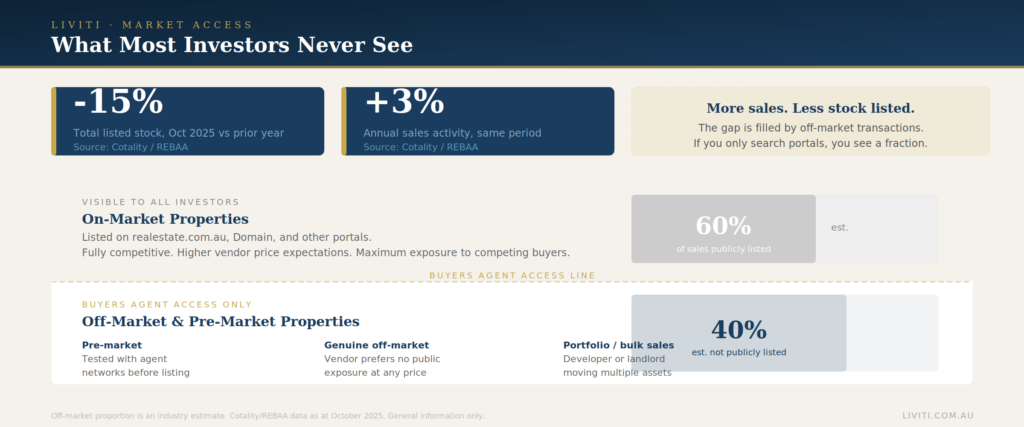
The latest Cotality data referenced by REBAA shows that while national sales activity rose nearly 3% year-on-year as at October 2025, total listed stock fell nearly 15% over the same period. In tight markets, the gap between what is available and what is publicly advertised is widest.
An investment buyers agent in Australia builds agent relationships in their target markets over years. Those relationships mean they receive calls about properties before they are listed, or properties that will never be listed at all. Most individual investors have no access to that pipeline regardless of how active they are on the portals.
2. They analyse deals with an investor’s eye, not a homebuyer’s heart
Buying a home and buying an investment are different decisions that require different assessment frameworks.
When you buy a home, the questions are personal: Do I like the kitchen? Is there space for the kids? Is the suburb close to my parents? These are valid questions for a home, and irrelevant for an investment.
An investment buyers agent assesses a property against a completely different set of criteria:
- Rental yield relative to comparable properties in the area
- Historic and projected vacancy rates
- Supply risk from planned new developments nearby
- Population and infrastructure drivers in the catchment
- Quality of the tenant pool and likely holding costs
The same property that feels appealing because of a renovated kitchen might have a yield of 2.8% and a vacancy rate of 9% in a suburb with three apartment projects in the pipeline. An experienced investment buyers agent sees that before making an offer. Most individual buyers see it after they have owned the property for two years and the rent is lower than expected.
3. They negotiate the purchase price and terms on your behalf
Negotiation is a skill. Most buyers use it once every three to five years. A good buyers agent does it multiple times each week.
The process of negotiating a property purchase involves more than the headline price. It includes settlement timing, deposit structure, inclusions, and building and pest conditions. All of these are negotiable and all of them affect the actual cost and risk of the purchase.
Professional buyers agents who operate daily in specific markets also have context that individual buyers lack. They know how long a property has been held, whether there are motivated vendors, what comparable properties have actually sold for (not just what they were listed at), and whether the market in that area is moving quickly enough to require urgency.
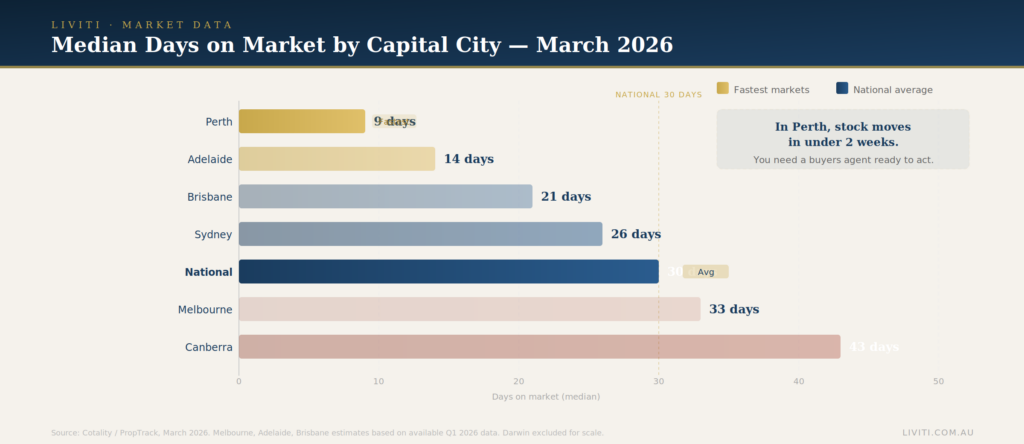
National rental vacancy stood at 1.6% in March 2026, with median time on market at 30 days nationally. In markets where stock moves quickly, having a buyers agent who can move decisively and negotiate from a position of market knowledge is a material advantage.
4. They shortlist properties based on yield, growth, and your strategy
Without a brief and a filter, property searching is just browsing. An investment buyers agent turns your financial goals into a specific acquisition brief, then filters everything that does not meet it.
A good buyers agent investment property brief covers your borrowing capacity, target yield, preferred property type and size, geographic preferences, and the role this particular purchase plays in your broader portfolio. That brief then guides every assessment they make.
This filtering function saves more time than most investors expect. A high-income professional spending evenings and weekends researching suburbs, attending open homes, and reading property reports is allocating attention that has significant cost. An investment buyers agent handles that process as their core job, and they do it with better data and more market context than any individual investor working part-time on it.
The shortlist they produce is not a list of what they found. It is a filtered output from a much larger assessment process, with the properties that did not meet the brief already removed.
5. They save you time, costly mistakes, and decision fatigue
This last point is where the fee case for a buyers agent investment property arrangement is most clearly made.
Property purchases are high-stakes decisions made under time pressure with imperfect information. That combination produces a specific kind of error: the decision made not because it is the best option, but because the investor has exhausted their capacity to keep evaluating alternatives.
Decision fatigue in property purchases looks like this: after inspecting forty properties across three months, the investor makes an offer on something they feel is good enough rather than waiting for something genuinely aligned with their brief. They overpay slightly because they are tired of negotiating. They skip due diligence steps they intended to follow because they want the process to be over.
An investment property buyer represented by a buyers agent does not experience this process the same way. The agent handles the search, the assessment, the shortlisting, and the negotiation. The buyer makes decisions from a curated set of well-analysed options rather than from a catalogue of raw market listings.
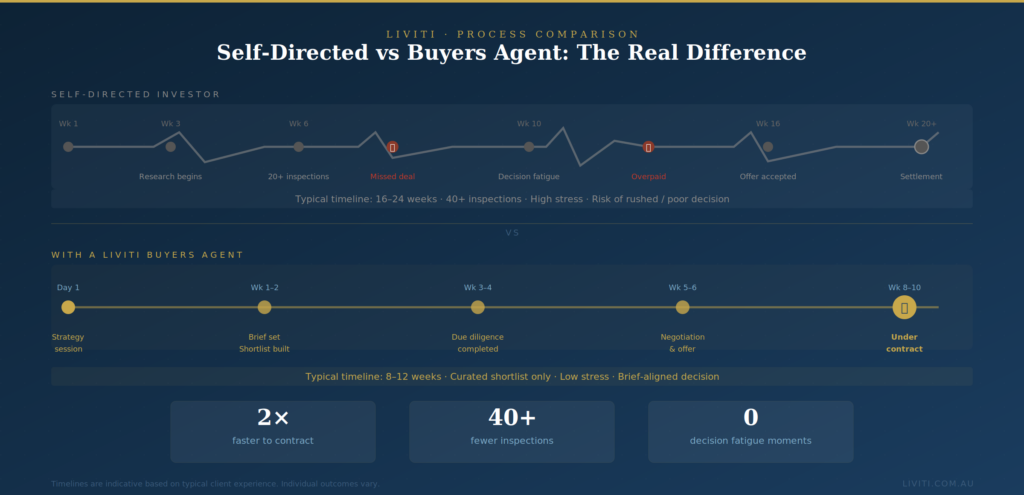
The savings from avoiding one bad purchase, one overpayment, or one suburb with structurally poor yield typically exceed the agent’s fee several times over. That is the calculation that matters.
Next steps
If you are planning your next investment property purchase, the starting point is knowing what brief a buyers agent would work from on your behalf. What is your borrowing capacity? What yield and growth profile fits your portfolio goals? What locations match the strategy?
Speak to the Liviti acquisitions team to define your brief and understand what a buyers agent working on your behalf would be looking for in the current market. The first conversation is free.