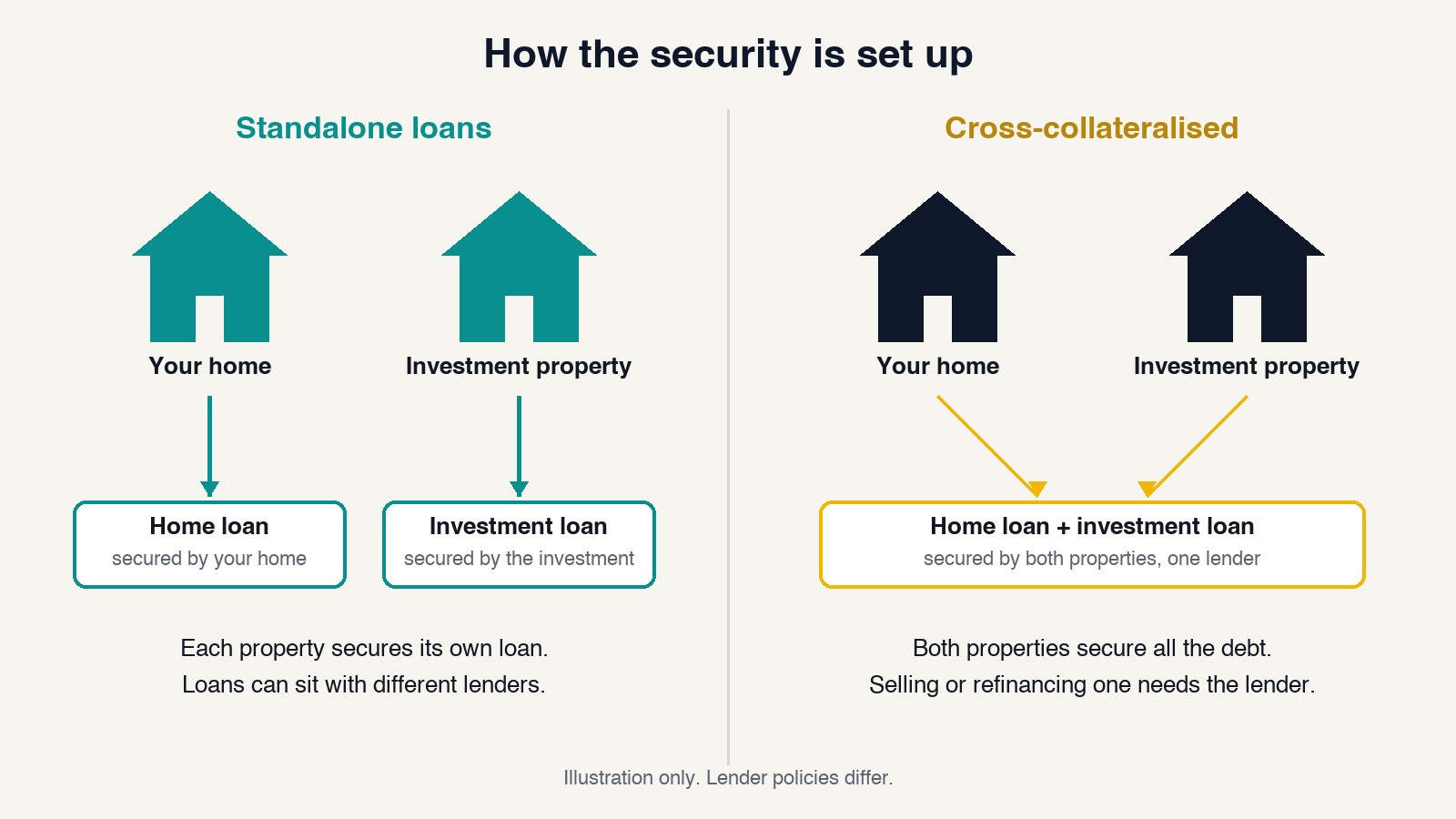
Cross-collateralisation is when one lender holds two or more of your properties as security for your loans, so every property backs all of the debt. It is common when investors use the equity in their home to buy an investment property. It is also called cross-securitisation, and it changes what happens when you sell, refinance or fall behind.
The structure is set when the loan is written, and it decides who controls the money when a property is sold. Liviti's finance team works alongside its strategy, buyer's agency and construction teams.
- * In a crossed structure, each property secures all of the borrowing with one lender, not just its own loan.
- * The alternative is standalone security, where each property secures only its own loan and loans can sit with different lenders.
- * Crossing leaves the amount you owe the same and can give the lender a say over the proceeds when a property is sold.
- * Selling, refinancing or releasing one property from a crossed structure needs the lender's agreement and usually a fresh valuation.
- * The security schedule in each loan contract shows whether your loans are crossed.
How cross-collateralisation works
With cross-collateralisation, the lender registers its security over several properties and ties them to the combined debt. Westpac describes one common version, where your existing home is used as collateral alongside the new investment property. You end up with two loans: your original mortgage and a new investment loan secured by both properties. Westpac notes this "may give you less flexibility than other ways of using equity", because separating the two securities later can take more work.
Why lenders cross-collateralise loans
From the lender's side, a pool of properties is stronger security than each property on its own. If one property falls in value or one loan falls behind, the lender can look to the whole pool. It also keeps all of the borrower's lending with one institution, because moving one loan can mean unwinding the security across the pool.
For the borrower, crossing is one way to buy an investment property without a cash deposit, because the equity in the home stands in for it. Standalone loans can use that equity too, as the example below shows.
Standalone loans as the alternative structure
The same purchase can usually be set up without crossing. Westpac lists other ways to use equity, including a home loan top-up and a separate supplementary loan account. A broker can tell you whether a lender will write standalone security for your purchase, and what it changes in your loan structure. With standalone security:
The equity from your home is released as a separate loan, secured only by your home, and used as the deposit.
The investment loan is secured only by the investment property.
Each loan can sit with a different lender, and each property can be sold or refinanced on its own.
A worked example of selling a crossed property
The figures below are illustrative only. They ignore purchase costs, selling costs, interest and price movement so the structure is easy to see.
Sam owns a home worth $1,000,000 with a $400,000 loan, and buys an investment property for $800,000 using equity as the deposit. Total borrowing ends up at $1,200,000 under either structure.
Standalone set-up
The home loan is increased to $560,000, releasing $160,000 for the deposit. It is secured by the home only.
The investment loan is $640,000, secured by the investment property only.
Crossed set-up
The original $400,000 home loan stays.
A new $800,000 investment loan is secured by both properties, with the same lender.
Later, Sam sells the investment property for $800,000.
Standalone: the $640,000 investment loan is repaid and Sam receives $160,000. The $560,000 home loan is untouched.
Crossed: because both properties secure the debt, the lender's agreement is needed to release the sold property, and the lender may require some or all of the $800,000 to be applied to the combined debt. If all of it is applied, the investment loan is repaid and Sam has $400,000 still owing and no cash in hand.
Net of cash in hand, Sam's position is the same in both cases, $400,000 after the sale, but who controls the cash differs. Under standalone security, Sam holds $160,000 and decides what to do with it, such as a deposit on the next purchase. Under the crossed structure, the lender can have a say in that decision. You can model your own figures with Liviti's property calculators.
The risks of crossing your loans
Sale proceeds. Releasing a property from a crossed structure needs the lender's agreement, and the lender may require sale proceeds to go towards the remaining debt, which can leave less cash than planned.
Falling values spread. A drop in one property's value affects the whole pool and can lead to a revaluation of the security. In a default, the lender can look to every property in the pool, including your home.
Lock-in. Refinancing one loan to another lender can mean unwinding the security across the pool.
Cost of unwinding. Releasing a property usually needs new valuations, and can bring discharge fees and new paperwork.
Is cross-collateralisation always a bad idea?
Not automatically. It can let you borrow when one property alone is not enough security, and it means dealing with one lender for every loan. The cost is flexibility, because selling, refinancing or releasing one property needs the lender's agreement. Whether that trade-off suits a purchase depends on your equity, your plans to sell or buy again, and the lender's policy, so speak to a licensed broker about your own situation.
How to check whether your loans are crossed
Read the security schedule in each loan contract. Crossed loans list more than one property, or the same property appears on more than one loan.
Ask your lender or broker to confirm the security structure in writing.
A title search shows who holds a mortgage over each property.
How to get out of cross-collateralised loans
There are two common ways to separate crossed loans, and both usually involve valuations, fees and new loan documents.
Ask the lender to release a property. This usually needs a current valuation, and the remaining loans must still meet the lender's policy on their own security.
Refinance one loan with another lender. If the lender declines a release, moving one loan to a new lender separates the security.
Setting up the security on investment lending
The security structure is usually set at the start, and it shapes every sale, refinance and purchase after it. Liviti's MFAA-accredited brokers compare more than 70 lenders through the Connective aggregator panel. They can set out the standalone and crossed structures side by side for your numbers.
Talk to Liviti's finance team about how your next purchase is secured.