Investment property depreciation is a tax deduction for the decline in value of a rental property's building and fittings. It has two parts: capital works deductions for the structure, generally 2.5% of the construction cost a year for 40 years, and plant and equipment deductions. Since 2017, second-hand plant and equipment in residential rentals generally can't be claimed.
That 2017 change is why depreciation now weighs differently on new and established property. Liviti's construction team works with a national builder network and structures builds with depreciation in view.
Key takeaways
- Depreciation has two parts: capital works (the building) and depreciating assets (plant and equipment).
- Capital works on residential rentals can be claimed for construction that started after 17 July 1985: 4% a year for 1985 to 1987, and 2.5% a year from 16 September 1987.
- Deductions start when construction is completed and can't exceed the construction cost.
- Second-hand plant and equipment in a residential rental generally can't be claimed after 1 July 2017, with some exceptions.
- A quantity surveyor's tax depreciation schedule sets out what can be claimed each year.
What property depreciation is
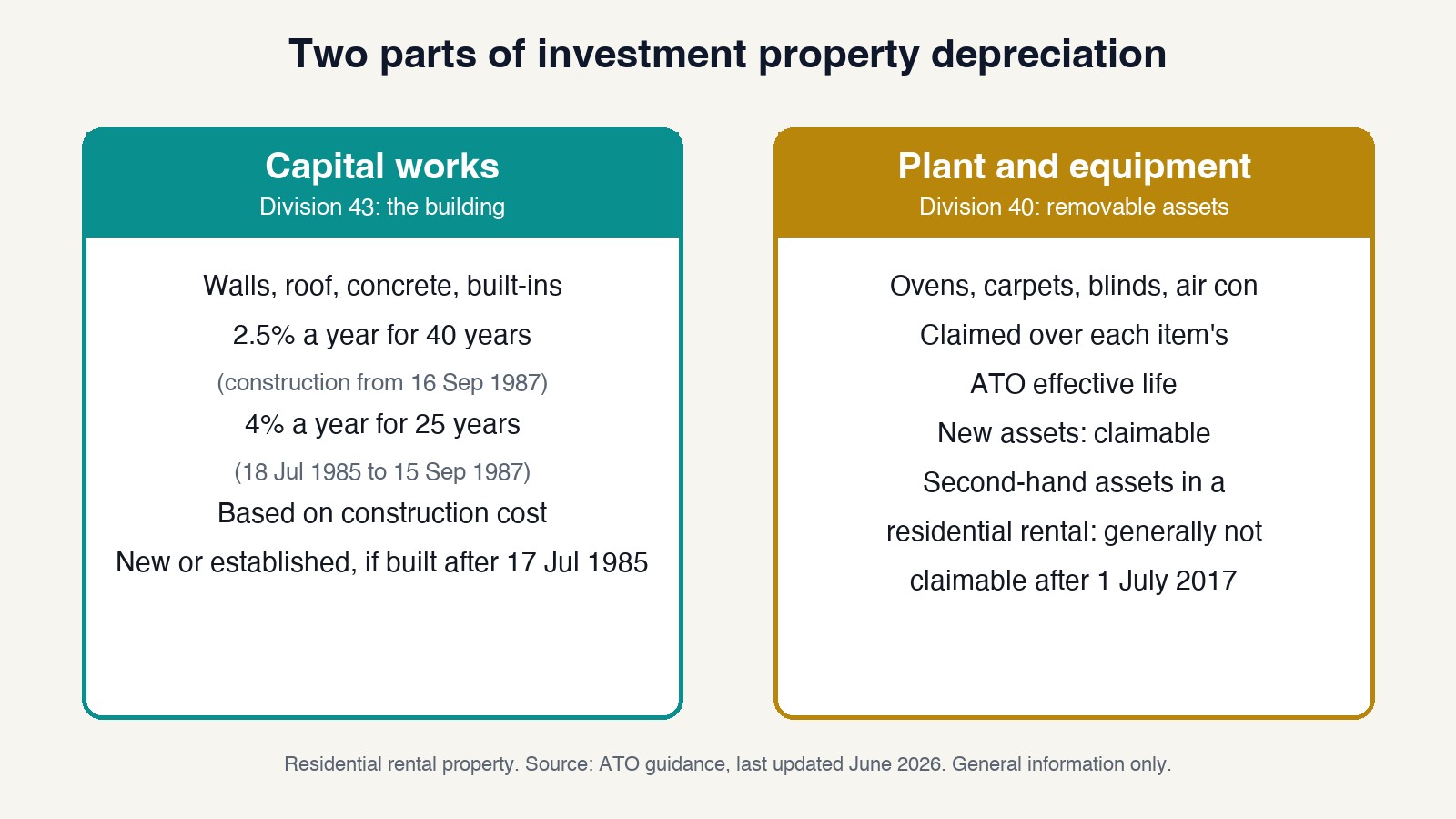
A rental property and its fittings lose value as they age. The tax system lets owners of income-producing property claim that decline as a deduction against their income, even though no cash changes hands in the year it is claimed. It is split into two categories, and the rules for each are different:
- Capital works, often called Division 43: the building structure and permanent fixtures such as walls, roofing, concrete and built-in cabinetry.
- Depreciating assets, often called Division 40 or plant and equipment: removable items such as ovens, dishwashers, carpets, blinds and air conditioners.
Capital works deductions (Division 43)
The ATO's rules for residential rental property depend on when construction started:
- Construction started 18 July 1985 to 15 September 1987: 4% a year, which spreads the deduction over 25 years.
- Construction started from 16 September 1987: 2.5% a year, which spreads it over 40 years.
- Structural improvements started from 27 February 1992: 2.5% a year.
- Construction before 18 July 1985: no capital works deduction for residential rental property.
Deductions start once construction is completed, run from the completion date, and can't exceed the construction expenses. The property must be rented, or genuinely available for rent on commercial terms.
The deduction is based on the cost of construction, not the purchase price. As an illustration, a home whose construction cost was $400,000 and which was completed in 2010 gives a 2.5% deduction of $10,000 a year until 2050. An investor who buys it in 2026 can claim the remaining years. The construction cost for an older property is usually estimated by a quantity surveyor.
Source: ATO, Work out your capital works deductions.
Plant and equipment deductions (Division 40)
Depreciating assets are claimed over each item's effective life, which the ATO sets for each type of asset. Items with shorter lives, such as carpets and appliances, are written off faster than the building itself, so in a new property these deductions are often largest in the first few years. There are two methods for working out the yearly decline in value, and a registered tax agent can explain which applies to you.
The 2017 rule on second-hand assets
The ATO puts it plainly: "In most cases you can't claim a deduction for second-hand depreciating assets after 1 July 2017." For a residential rental, previously used plant and equipment can generally only be claimed if you bought the asset before 7:30 pm on 9 May 2017 and installed it in the rental property before 1 July 2017.
The main exceptions are where you bought the residential rental property before 7:30 pm (AEST) on 9 May 2017, you are carrying on a business of letting rental properties, the property is not used to provide residential accommodation, or the owner is an excluded entity such as a company or a superannuation fund that is not a self-managed super fund.
New property is treated differently. Assets bought with a newly built or substantially renovated property can be claimed if no one was previously entitled to a deduction for them, and either no one lived in the property before you bought it, or the asset was installed for use, or used, at the property and you bought it within 6 months of it being newly built or substantially renovated.
Sources: ATO, Second-hand depreciating assets and ATO, Depreciating assets in rental properties.
Depreciation on new and established property
- A new build or a property bought new: capital works deductions on the full construction cost from completion, plus plant and equipment deductions on the new assets, within the ATO's conditions.
- An established property built after 17 July 1985: capital works deductions only for whatever remains of the 25 or 40 year period from completion. By 2026 nothing remains for buildings on the 4% rate (construction started 1985 to 1987), and little or nothing for buildings finished in the late 1980s. Existing second-hand plant and equipment is generally not claimable; new assets you install yourself can be.
- An established property built before 18 July 1985: no capital works deduction on the original building, though later qualifying renovations may be claimable.
Depreciation is one input among many: location, land, rent and growth still drive the investment. For the wider comparison, see new build vs established investment property. Eligible new dwellings also keep full negative gearing for the first buyer after the 2026 Budget changes; see property investment strategies in Australia.
How to claim depreciation
- Get a tax depreciation schedule. A quantity surveyor estimates the construction cost and identifies the depreciating assets, then sets out the deductions available each year.
- Give it to your tax agent. The yearly figures go into your tax return alongside your other rental income and expenses.
- Keep it updated. Renovations and new assets change the schedule, and records matter when the property is sold.
Depreciation interacts with your other rental deductions and with capital gains tax when you sell, so speak to a registered tax agent about your situation.
Building with depreciation in view
For investors weighing a new build, the depreciation available is part of the cash flow from the first year. Liviti's construction team works with a national builder network and structures builds with depreciation in view, alongside Liviti's strategy and finance teams. See how Liviti's construction service works, or model your cash flow with the Liviti calculators.
Frequently asked questions
How much depreciation can I claim on an investment property?
It depends on the construction cost, when the property was built and what assets it has. For capital works, the usual rate is 2.5% of the construction cost a year for 40 years, so a $400,000 construction cost gives $10,000 a year. Plant and equipment adds more for new assets. A quantity surveyor's schedule sets out the exact figures.
Can I claim depreciation on an established property?
Often, for the building, but it depends on its age. Capital works deductions apply where construction started after 17 July 1985, and only for what remains of the 25 or 40 year period from completion, so late-1980s buildings have little or nothing left. Second-hand plant and equipment generally can't be claimed after 1 July 2017 unless an exception applies.
What is Division 43?
Division 43 is the part of the tax law covering capital works deductions: the building structure and permanent fixtures of an income-producing property. For residential rentals, the rate is 2.5% a year for construction started from 16 September 1987, or 4% for construction between 18 July 1985 and 15 September 1987. Deductions can't exceed the construction cost.
Do I need a tax depreciation schedule?
For most investors, a schedule is the practical way to claim. Older properties often lack construction cost records, and a quantity surveyor can estimate the construction cost and list every depreciating asset with its yearly deduction. Your tax agent then uses the schedule in your return.