
Property Investment Fundamentals

Australian residential property

Property Investment Fundamentals

Liviti
Property Investment Fundamentals

How do you calculate borrowing capacity for an investment property?

Borrowing capacity for an investment property is determined by a lender’s serviceability assessment — a calculation that tests whether the borrower’s income is sufficient to cover the proposed loan repayments at an assessed interest rate, after all other financial commitments. Key inputs into a borrowing capacity calculation: Income. Lenders include base salary, bonuses (usually at …

Daniel Chadrawy28 April 2026
Liviti
Property Investment Fundamentals

What is land tax in Australia and how does it affect property investors?

Land tax is a state and territory government tax levied annually on the total unimproved value of taxable land held by an individual, company, or trust above a threshold. It applies to investment properties — not to an owner’s primary residence (with limited exceptions). State-by-state thresholds (approximate, check current rates):– NSW: $1.075M threshold (2025), with …

Daniel Chadrawy28 April 2026
Liviti
Property Investment Fundamentals

What is an SMSF and can it invest in property?

An SMSF — Self-Managed Super Fund — is a private superannuation fund that gives members direct control over how their retirement savings are invested. SMSFs are regulated by the Australian Taxation Office and must comply with superannuation law. Can an SMSF invest in property? Yes. An SMSF can invest in residential or commercial investment property, …

Daniel Chadrawy28 April 2026
Liviti
Property Investment Fundamentals

What is property depreciation and how do investors claim it?

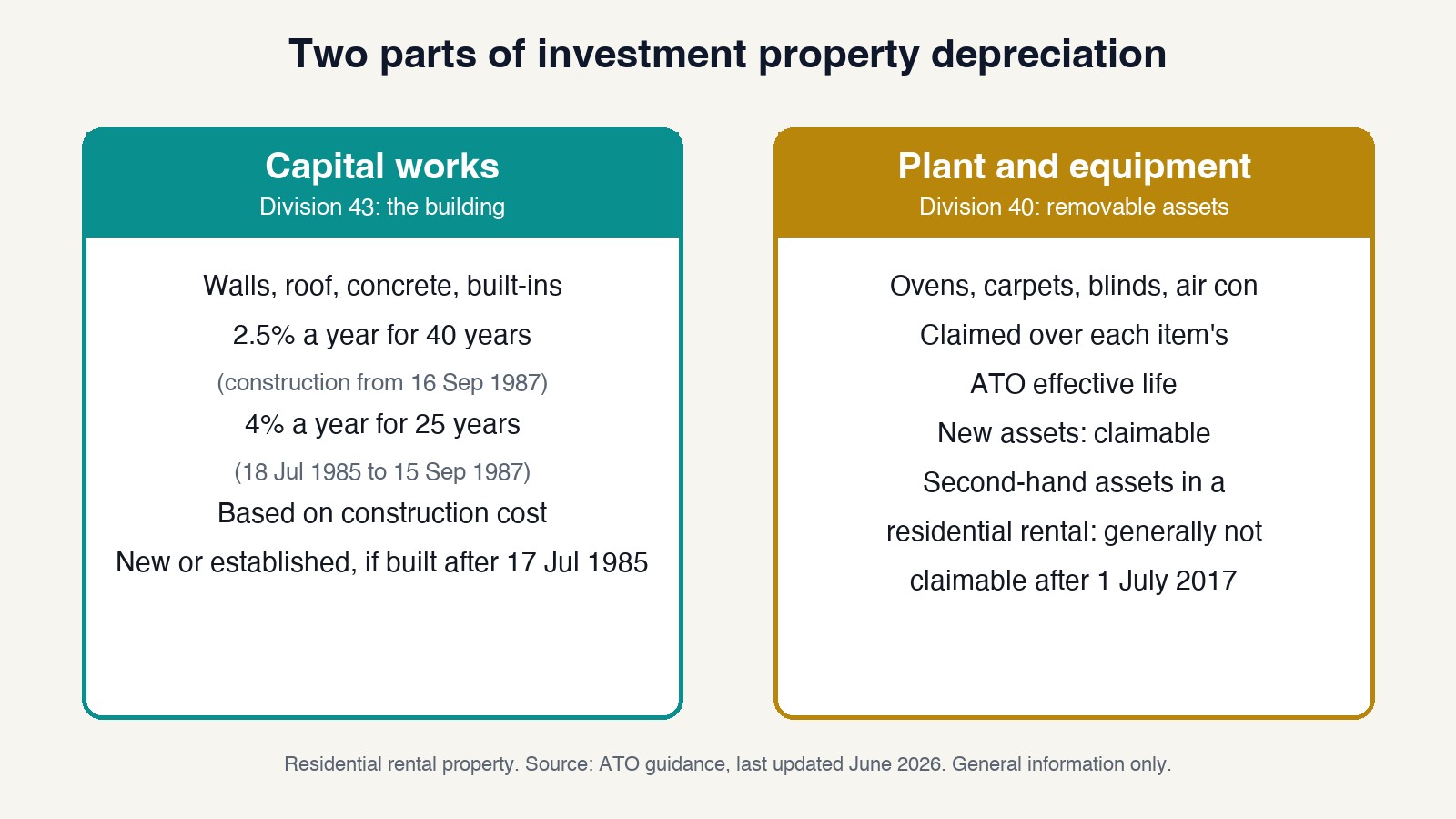
Property depreciation is a non-cash tax deduction that allows investment property owners to claim the decline in value of the building structure and its fixtures and fittings against their taxable income. It is one of the most underutilised tax benefits available to Australian property investors. Two types of depreciation: Division 43 — Capital Works. The …

Daniel Chadrawy28 April 2026
Liviti
Property Investment Fundamentals

What is rental yield and what is a good yield for an investment property in Australia?

Rental yield measures the annual rental income generated by an investment property as a percentage of its value. It is one of the most important metrics for comparing investment property performance across different markets and property types. Gross rental yield = (Annual Rent ÷ Property Value) × 100 Example: A property worth $600,000 generating $580 …

Daniel Chadrawy28 April 2026
Liviti
Property Investment Fundamentals

What is a property investment strategy and how do I develop one?

A property investment strategy is a structured plan that aligns your property acquisitions with specific financial goals — income generation, wealth accumulation, tax minimisation, or retirement funding. Without a strategy, property purchases tend to be reactive, influenced by market commentary, and disconnected from the investor’s actual financial position. Step 1: Assess your financial position. Document …

Daniel Chadrawy28 April 2026
Liviti
Property Investment Fundamentals

How does negative gearing work in Australia?

Negative gearing in Australia occurs when the costs of owning an investment property exceed the rental income it generates. The resulting loss — the difference between income and expenses — can be deducted from the investor’s other assessable income, reducing their overall tax liability. Eligible costs. Tax-deductible costs on a negatively geared investment property include …

Daniel Chadrawy28 April 2026