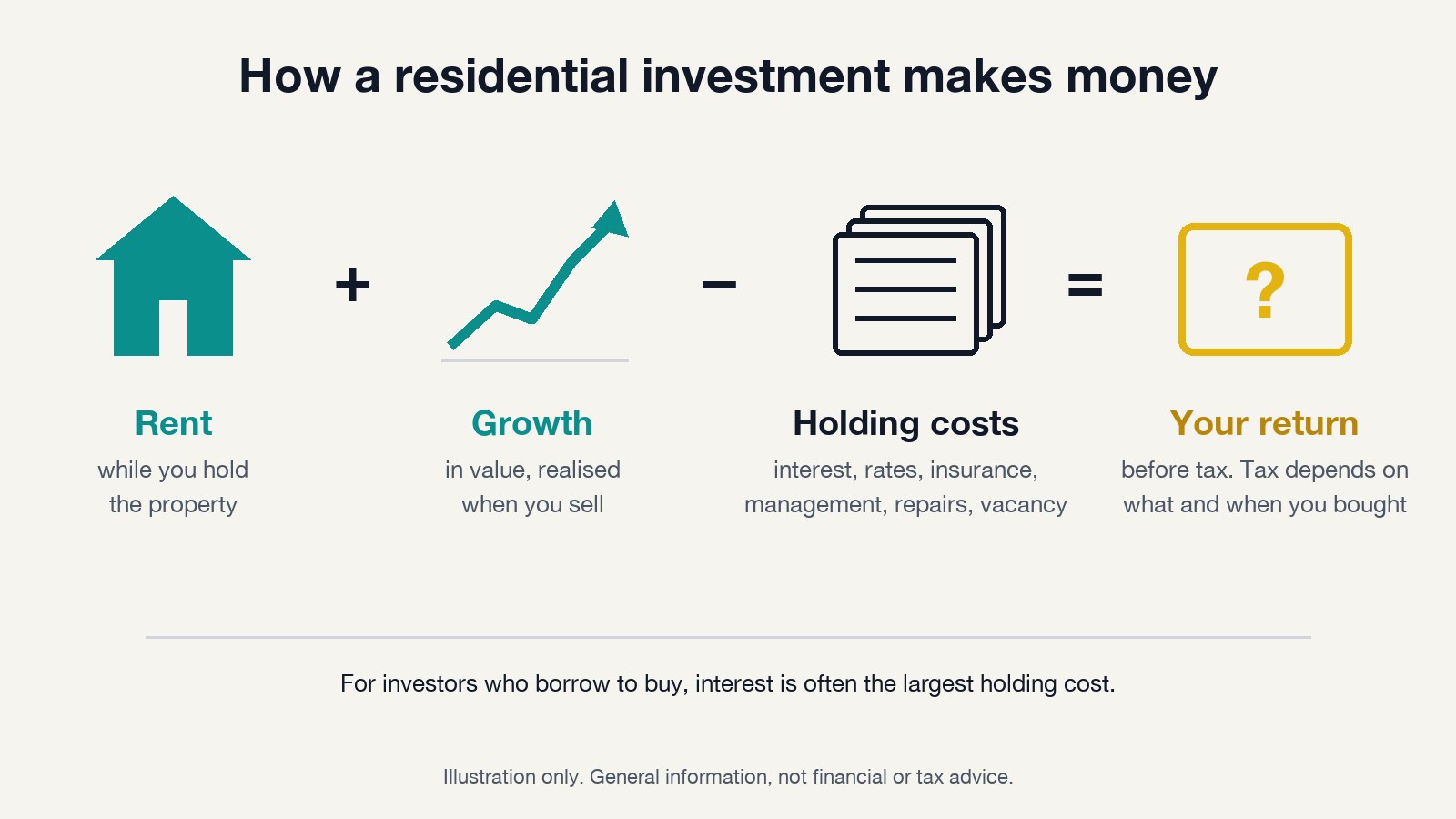
Residential property investment is buying a house, townhouse, unit or apartment to rent to tenants rather than to live in. The return comes from two places: rent while you hold the property, and any rise in its value by the time you sell. Many investors fund the purchase with a loan, so the costs of borrowing and holding the property shape the result as much as the rent does.
Key takeaways
Residential property investment means owning a dwelling that you rent out, such as a house, townhouse, unit or apartment.
Your return depends on rent, capital growth and the cost of holding the property, including interest, rates, insurance and vacancy.
From 1 July 2027, rental losses on established homes bought after 7.30pm on 12 May 2026 can no longer be negatively geared, while the first buyer of an eligible new build still can.
How you own the property, in your own name, jointly, through a company or through a trust, can change how it is taxed and how land tax applies.
The main risks are falling values, vacancy, rising interest rates, negative cash flow and the time and cost of selling.
What counts as residential property
Residential property is any dwelling built for people to live in. For investors, it usually means one of these:
Houses: a freestanding home on its own block. You own the land, which is often where long-term growth comes from.
Townhouses: attached homes, usually with a small yard, often under a strata or community title.
Units and apartments: homes in a shared building, owned under strata title, with body corporate fees for shared areas.
Dual occupancy and granny flats: two dwellings on one block, which can bring in two rents from one purchase where council rules allow.
The other split that matters is new or established. A new build is a dwelling nobody has lived in before, and an established property is one that has been lived in or sold before. For tax, the 2026 rules use a narrower test, set out in the Budget section below. New build vs established investment property compares the two in more detail.
How a residential investment makes money
A residential investment earns money in two ways: rent while you hold it, and any growth in its value. Growth also builds equity, which some investors borrow against to buy again, adding to their debt. Rental yield measures the first part: annual rent as a share of the property's value. To calculate it, see gross vs net rental yield, and capital growth vs rental yield for the trade-off between the two.
Cash flow is what is left of the rent after the holding costs. Here is a hypothetical example, using assumed figures rather than current interest rates, market rents or a forecast:
Purchase price: $750,000, with a $600,000 loan at 6% interest only
Rent: $650 a week, or $33,800 a year, less two weeks' vacancy ($1,300), for $32,500 of rent received
Interest: $36,000 a year
Council and water rates: $2,800
Landlord insurance: $1,800
Property management at 7% of rent received: about $2,275
Repairs and maintenance: $1,500
Result, before tax: about $11,875 a year more in costs than in rent, not counting strata fees, land tax or principal repayments
The gross yield here is 4.5% ($33,800 divided by $750,000). A property like this is negatively geared: it runs at a loss each year, and the investor relies on capital growth to come out ahead. From 1 July 2027, whether that loss can reduce tax on your salary depends on when you bought and whether the property is an eligible new build. You can test your own figures with Liviti's property calculators.
Residential vs commercial property
Commercial property covers offices, shops, warehouses and industrial sites. The two work differently for an investor:
Tenants and leases: residential leases are usually short, while commercial leases tend to run for several years.
Vacancy: homes generally re-let faster, while a commercial property can sit empty for longer between tenants.
Lending: lenders usually ask for a larger deposit on commercial property, and residential loans are easier to get.
Costs and management: commercial tenants often pay more of the outgoings, while residential owners pay most holding costs themselves.
Commercial property tends to suit experienced investors who put income ahead of growth.
What it costs to buy and hold
The upfront costs come before the first rent payment:
Deposit: a common guide is 20% of the purchase price. Borrow more than 80% and you may have to pay lenders mortgage insurance, which protects the lender if the loan is not repaid, not you. Lenders mortgage insurance for investors explains when it applies.
Stamp duty: a state or territory tax you pay when you buy or are transferred a property, worked out under each state's rules (Revenue NSW, State Revenue Office Victoria, Queensland Revenue Office). It is often the largest upfront cost after the deposit. Stamp duty on investment property walks through the calculation.
Legal and inspection costs: conveyancing, building and pest inspections, and loan fees.
Then come the holding costs, every year you own the property: interest, council and water rates, landlord insurance, strata or body corporate fees, property management, maintenance and any weeks without a tenant.
Land tax is easy to overlook. It is a state tax charged each year on the value of land you own, with exemptions such as your home, once your combined landholdings pass a threshold. Each state sets its own thresholds, rates and the date it checks who owns the land. Read more in land tax for property investors.
Many holding costs can be claimed as tax deductions while the property is rented, or held to produce rental income and available for rent on commercial terms, under the ATO's rules for claiming rental expenses. Capital works deductions on the building, and depreciation on eligible fittings, can add to those deductions, though limits apply to fittings in established properties. Our property depreciation guide explains the limits.
How the 2026 Budget changed the tax rules
Two tax changes from the 2026 Budget are now law under the Treasury Laws Amendment (Tax Reform No. 1) Act 2026 and a companion tax rates Act, both of which received Royal Assent on 26 June 2026. The ATO's summary explains both.
Negative gearing. From 1 July 2027, negative gearing on residential property is limited to eligible new builds, for individuals, partnerships, companies and most trusts. Properties held at 7.30pm (AEST) on 12 May 2026, including contracts signed but not yet settled, can still be negatively geared until they are sold. Established properties bought after that time can be negatively geared only until 30 June 2027.
Treasury's Budget explainer describes an eligible new build as a dwelling built on vacant land, or where an existing property is knocked down and replaced with more dwellings, and only the first buyer keeps the benefit. The Act leaves the detailed requirements to a ministerial instrument, so the final definition may differ.
Capital gains tax. For gains made from 1 July 2027, the 50% capital gains tax discount for individuals, trusts and partnerships is replaced by cost base indexation and a 30% minimum tax on capital gains. Property owned before 1 July 2027 is split at that date: the gain made before 1 July 2027 is taxed under the current rules, and the gain after it under the new ones. First buyers of eligible new builds can choose either method, and your main residence stays exempt.
A third measure, a 30% minimum tax on the net income of discretionary trusts from 1 July 2028, passed Parliament on 26 November 2026 in a bill that also amends the negative gearing rules for new dwellings. It was awaiting Royal Assent.
What negative gearing is explains how a rental loss works. These are general rules, not advice for your situation, so check how they apply to you with your accountant.
Last checked: 26 November 2026. Other bills affecting these rules had also been introduced.
Ways to hold an investment property
You can buy in your own name, jointly with a partner, through a company or through a trust. Joint owners can hold the property as joint tenants, where a deceased owner's interest passes automatically to the surviving owners whatever their will says, or as tenants in common, where each owner holds a set share they can sell or leave in a will. The structure can change how rental income and capital gains are taxed, who can use a rental loss, and how land tax applies.
Changing the structure after you buy can trigger stamp duty and capital gains tax, and may affect grandfathered negative gearing, so settle it with your accountant before you sign. Buying property through a trust covers one of those options in detail. Self-managed super funds can also own property, under strict rules. Get advice from a licensed financial adviser and your accountant before deciding whether that suits you.
The risks to weigh before buying
Vacancy: every week without a tenant is a week of costs with no rent.
Interest rates: a rise in rates lifts your repayments. APRA requires banks to test new borrowers at a rate at least 3 percentage points above the loan rate, and kept that buffer in place in November 2026, though banks can make exceptions. Leaving a similar margin in your own budget makes a rate rise easier to absorb.
Negative cash flow: if the costs outrun the rent, you fund the gap from your income, possibly for years.
Selling: property takes time to sell, and agent fees, marketing, legal costs come out of the proceeds, and any capital gains tax is due on the gain.
Market cycles: values can fall as well as rise, and a property bought at a peak can take years to recover.
Bad advice: In late 2024, ASIC named unscrupulous property investment schemes a key enforcement priority, warning about consumers being enticed into high-risk property development schemes. The warning signs are set out in how to spot a property spruiker.
How to start a residential property portfolio
A first investment property works best as part of a plan rather than a one-off purchase:
Set your goal and timeframe. Decide whether you are buying mainly for growth, income or both.
Work out your borrowing capacity. A broker can compare lenders and show what you can borrow.
Choose a strategy. Property investment strategies in Australia sets out the common approaches.
Settle the ownership structure. Agree it with your accountant before you sign.
Research and check the property. Look at rental demand, supply and the building itself before you commit.
Buy, then review. Track the rent, costs and value each year, and decide whether to hold, sell or refinance.
Where a buyer's agent fits
A buyer's agent works for you, not the seller. They search for properties that match your strategy, do the due diligence, negotiate the price and manage the purchase through to settlement. Liviti's buyer's agency works alongside its strategy and finance teams, so the property, the loan and the plan are set together.
See how Liviti's buyer's agency works, or book a strategy session to talk through your first or next purchase.
Frequently asked questions
How much do you need to start investing?
Expect to need a deposit, often around 20% of the price, plus stamp duty, legal and inspection costs before settlement. Some lenders accept equity in a home you already own instead of cash, which means borrowing more against that home. A mortgage broker can work out your borrowing capacity and how much cash you would need upfront.
Is residential property a safe investment in Australia?
No investment is free of risk. Property is often bought with a loan, so a fall in value takes a bigger share of your own money, and a long vacancy still leaves the interest to pay. A cash reserve, room in your repayments and a property tenants want all make a downturn easier to ride out.
Can you still negatively gear a residential property?
Yes, in some cases. A property you held before 7.30pm (AEST) on 12 May 2026 keeps its current treatment until you sell it, and the first buyer of an eligible new build can still negatively gear it. An established home bought after that time can be negatively geared only until 30 June 2027.
Do you pay land tax on an investment property?
Usually, once the combined value of your taxable land passes your state's threshold. Your home is generally exempt, but an investment property, holiday home or vacant land can count. NSW and Victoria check who owns the land at midnight on 31 December, Queensland at midnight on 30 June, and trusts can face lower thresholds or none at all.
General information only. This article does not take into account your objectives, financial situation or needs, and it is not financial, tax or legal advice. Speak to a licensed professional before acting on it.